
Implementing a new Association Management System (AMS) can be an association game-changer or a costly blunder. An AMS solution touches nearly every element of your operations, from membership management and event planning to communications and reporting. It is worth getting it right because your AMS is not software; it’s the backbone of your association.
But often, associations jump into implementation without a plan, only to find gaps, inefficiencies, or compatibility problems later on. Requesting the proper questions prior to you commit can save time, money, and headache and position your association for long-term success.
Some key questions to utilize as a roadmap for your AMS solutions analysis and implementation follow:
What to Ask Before Selecting an AMS
Before getting into AMS vendors and demos, step back and assess your needs and priorities. Go through the following critical questions; careful answers will help inform your process and position your association for success in the long term.
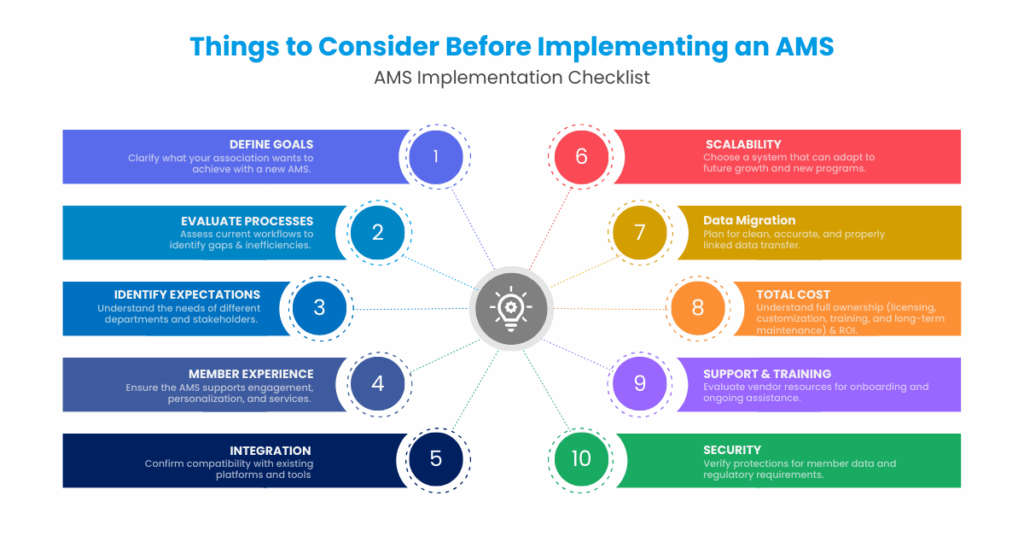
1. What are your core goals for implementing a new AMS?
All successful AMS implementations begin with clarity. Step back before you explore vendors and determine what success will mean for your association. Are you attempting to increase member participation, streamline event management, improve reporting, or integrate more closely with other business systems?
Understanding your objectives allows you to focus on AMS functionalities and avoid being shell-shocked by a sea of options. For instance, if the aim is membership growth, you should concentrate on systems that are fortified with strong automated renewal capabilities, one-to-one communications, and engagement metrics. Ensuring your investment is giving real returns by aligning your goals with your AMS functionality.
2. Have you evaluated your current processes?
A common mistake is assuming the new AMS will fix all organizational pain points without a clear understanding of current processes. Assess your current systems and processes thoroughly. Determine gaps, inefficiencies, and bottlenecks that are created.
This is also the time to engage stakeholders across departments. Make use of RFPs, vendor presentations, and internal interviews to get feedback. The more you know where your processes right now fall short, the more adept you are at selecting a system that really does possess the needs it promises to cover, especially with the assistance of experienced AMS consulting experts.
3. What does your association expect from an AMS?
An AMS is just as successful as the problems it solves. Different departments will have different requirements—finance will desire seamless accounting integrations, membership staff will require better engagement tracking, and events staff will desire automated processes for registration.
Ask specific questions: Will the AMS solution accommodate multi-tiered membership schemes? Will it generate real-time reports to your board? Will it enable inter-department cooperation without replication undertakings? Having these needs in mind before installation keeps you from implementing an AMS solution with excessive feature richness but insufficient alignment with your primary activities.
4. How will the AMS enhance member interaction and services?
Opt for features that promote interaction, including surveys, forums, event management, and auto-messages. Useful reporting can Member experience must be at the forefront of any choice you make with an AMS. The right system allows you to track member interactions, likes, and participation history so you can personally communicate and serve them.
give you an idea of what makes members content and loyal so that you can design programs and services that will deliver value.
5. Does this AMS integrate with your existing tools?
Integration is essential to the productivity of AMS services. Your AMS should integrate well with other platforms such as Learning Management Systems (LMS), accounting programs such as QuickBooks or Xero, inventory control, and your website.
Single Sign-On (SSO) also can enhance the member experience by providing one login to multiple platforms. Poor integration usually leads to duplicated work, information silos, and irate staff. Front-end compatibility saves tedious workarounds down the line.
6. Is the system flexible and scalable for future expansion?
Your AMS will have to grow with your association. Consider your membership aspirations in the future, new programs, and expanding storage needs for data. A scalable AMS can handle larger databases and more complex operations without having to overhaul itself entirely.
Flexibility is also essential. User interfaces must be configurable, and the system must facilitate adoption of new technologies such as AI-driven analytics or future-generation automation. Investment in an AMS that is flexible and scalable protects your member organization from costly future upgrades, a factor to consider when selecting AMS vendors.
7. What are data migration and data quality challenges?
Data migration is generally underestimated with AMS implementations. Determine which records to transfer, which to keep, and what to do with duplicates or errors. Maintenance of relationships between records, like member contacts and event attendance, is important to maintain business continuity.
A well-thought-out migration plan will have your data accurate, complete, and ready to take advantage of the functionality of your new system from day one.
8. What is the total ownership cost?
Besides licensing fees, account for the implementation cost of AMS. Customization, integration, training, support, and maintenance may be expensive. Avoid unnecessary modules or features that increase costs without contributing measurable value.
Understanding the total financial implication helps your association budget correctly and monitor ROI in the long run. Dealing with AMS service providers makes you understand both short-term and long-term costs.
9. What types of vendor support and training should you anticipate?
Even top-notch AMS solutions must be trained and brought on board. Ask AMS vendors about materials such as live sessions, knowledge bases, or assigned account managers. Determine the process for escalating higher-priority problems and response times. Successful AMS consulting and ongoing training allow employees to successfully deploy new features, avoid downtime, and make your investment in AMS solutions pay dividends in the long term through efficient use and member satisfaction.
10. How does the AMS deliver security and compliance?
Security is top on the list when considering AMS solutions. Make sure the system employs encryption, role-based access permissions, and ongoing security patches to safeguard sensitive information. Query vendors about compliance with GDPR or SOC 2 standards and how updates become transparent.
If you have AI functionality, ensure that AMS services keep member information encrypted and never exposed—establishing trust while maintaining member confidentiality.
Final Thoughts
An AMS is an asset, but only when it furthers your association’s mission, workflows, and member engagement plans. The proper questions upfront allow you to choose a system that isn’t merely running but revolutionary.
Having these questions on hand in the form of a checklist can direct your evaluation process and minimize the risk of expensive missteps. And if the process really does seem daunting, having working relationships with experienced AMS consulting and AMS services professionals like Aplusify can make evaluation, rollout, and all the steps in between easy and seamless to facilitate today’s operations and tomorrow’s growth.
Senior Project Manager, Aplusify
With over a decade’s worth of Salesforce and Fonteva experience, Manabendra Sarkar is a seasoned consultant and solution architect for associations that seek to implement digital transformation. A Senior Project Manager with Aplusify, he brings technical proficiency together with an in-depth understanding of association business models to come up with solutions that are innovative yet practical.
His organized, clarity-driven approach ensures stakeholder alignment and confidence throughout—from discovery to go-live. Outside of projects, he’s dedicated to making teams better through training, reusable frameworks, and repeatable delivery processes. His approach is grounded in the belief that clarity creates confidence.