
Artificial intelligence (AI) is today one of the most discussed topics in the association market. From vendor demos to keynote presentations, the promise is everywhere: AI will personalize experiences, transform member engagement, and streamline operations. But lost in the hype, association leaders naturally ask a more practical question: how exactly do we make AI for associations work in our day-to-day operations?
For associations running a Salesforce-based Association Management System (AMS), the potential is significant. Your AMS already consolidates deep member data and integrates with Salesforce tools, so it’s natural to use it as a basis for AI adoption.
This blog provides a roadmap to go from hype to help, showing where AI fits in AMS, real-world steps to use it, and how to measure actual outcomes.
Separating the Hype from the Real Impact of AI
AI is often sold as a quick fix, but without a clear strategy, the results can be disappointing. As a result, with no clear objectives associations tend to fail in their approach or barely make a difference.
The issue is two-fold: unrealistic expectations and a failure to define use cases. For mission-oriented organizations with limited budgets, following trends for their own sake can waste time and budget. For instance, applying a trendy chatbot that doesn’t synchronize with member data can infuriate users rather than assist them.
The key to success is reframing AI as a practical tool and rather than as a fix for specific issues. Start with asking the question: What problems do we have to solve—member churn, support backlog, or event engagement—and can we engage AI’s assistance with them? This attitude roots AI adoption in mission and value, not hype.
Where AI Fits in Salesforce AMS
With Salesforce as the core, associations already have access to integrated AI capabilities. An AMS based on Salesforce keeps member information, engagement history, event activities, and more in one place. This consolidated data is the fuel that drives AI to be powerful. These are some actual areas where AI can make an impact:
Member Retention
Predictive analytics can be used to analyze member engagement behavior. Metrics like event attendance or online usage can spot members at high risk of lapse. Staff can then proactively reach out with targeted renewal campaigns to drive up retention levels.
Member Services
AI chatbots and virtual assistants, with Salesforce data integrated, can answer routine questions 24/7. They lower support volume while sending more complex matters to employees. Automated ticket routing is also possible, enabling quicker response. Salesforce notes that AI chatbots are able to respond to customer inquiries with accuracy rates as high as 93%, saving human agents the load while having high-quality responses.
Event Personalization
Based on the AMS event history, AI in event personalization can suggest sessions or networking groups to which attendees have expressed interest. This produces a customized experience that increases satisfaction and turnout.
Marketing and Content
AI for marketing can segment members into relevant groups and propose messaging for each. Meanwhile, AI tools for marketing can help create author emails, posts, or flyers, making it easier for staff to produce content quickly without sacrificing personalization. Studies done by Salesforce suggest that organizations with AI-based personalization have seen conversion rates increase by as much as 200%, with the company also pointing out that email and SMS activity increased by 70% in two years.
Analytics and Insights
AI-powered dashboards can help discover hidden trends. For instance, which benefits have the greatest impact on renewals or which segments are least active, these insights can be easily derived from dashboards. Decision-making will improve with data-driven predictions. Salesforce is stressing that over 50% of customers expect their organizations today to leverage their data and preferences to make them more personalized.
In all these fields, the elegance of employing AI in an AMS based on Salesforce is the convergence of technology and your current processes. AI enhances the AMS’s position as something more than a repository—it becomes an engagement and decision-making platform.
Steps to Operationalize AI
Installing AI in your association is not a one-click installation, it’s a strategic process. By using a guided roadmap, you can embed AI in your Salesforce-based AMS in a manner that delivers tangible value and reduces risk. Below are the most important steps to transition from AI idea to daily reality:
Define Use Cases
Begin small with simple objectives. Examples include decreasing the average response time by 20% through a chatbot or increasing first-year members’ renewal rates through predictive scoring.
Evaluate Data Readiness
Clean, correct data is essential. Get your Salesforce records current, complete, and consolidated. Consolidate data sources where necessary so AI has an entire view.
Take Advantage of Available Tools
Start with native AI capabilities within Salesforce. Associations can explore Einstein Prediction Builder, Einstein Bots, or analytics add-ons, then purchase third-party tools if necessary. These easily integrate with AMS data and tend to have less setup.
Pilot Before Going Big
Pilot AI in a test environment. Roll out a chatbot for a small member population or pilot a churn model for one renewal cycle. Get feedback, iterate, then roll out.
Train Teams and Refine Workflows
Employees must understand how AI integrates into their everyday workflows. Train them to predict outputs, work with chatbots, and refine outreach based on insights. Modify SOPs so AI observations become part of routine.
Monitor and Fine-Tune
Work with AI as iterative. Track performance, capture feedback, and update models or processes frequently. AI learns to be better, but only if it’s being tracked and optimized.
Prioritize Ethics and Trust
Be transparent when members are using AI (e.g., inform them when they’re chatting with a bot). Establish internal standards for data usage and privacy. Have a responsible and transparent approach along the way. Ensure that you have ethical use rules for AI, data privacy, and transparency to your members.
Measuring Success
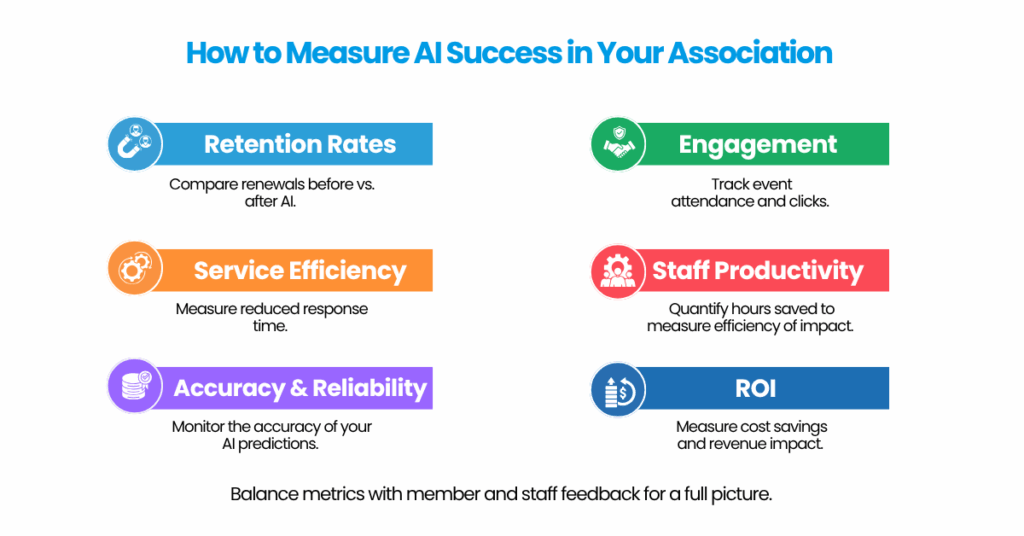
AI implementation is not the end of the race; you also need to check that these new technologies are having a positive impact. Establishing success metrics at the beginning will enable you to measure the ROI (return on investment) and effect of your AI programs. There are a number of important metrics and indicators that an association should monitor:
Retention Rates: Compare pre- and post-predictive analytics renewal percentages. Were renewals boosted by outreach to struggling members?
Engagement: Always keep track of the results of AI recommendations. Monitor event attendance, session choices, or email click-through rates for members who received them.
Service Efficiency: Record decreases in average response time, backlog, and staff workload following deployment of chatbots or case routing automation.
Staff Productivity: Model hours saved through automation of routine tasks, and describe in what ways that time gets reinvested back into higher-value work.
Accuracy and Reliability: For predictive models, measure frequency with which identified members aligned with actual results. For chatbots, measure rates of resolution and member satisfaction.
ROI: Gauge financial effect, for example, revenue preserved through improved retention or cost reduction through efficiency gains.
Balance these with staff and member input. Numbers are only part of the narrative, but perception—whether or not AI is making processes simpler and experiences more positive—is just as vital.
Conclusion
For associations on Salesforce-based AMS, AI is not a pipe dream for the future—it’s here today as an actionable tool. By cutting through hype and setting clear objectives, associations can leverage AI to keep more members, serve members better, and tailor engagement.
The path is simple: establish use cases, sanitize your data, begin with native tools, pilot slowly, train your staff, and measure success. Associations that follow this careful plan will find AI go from buzzword to business as usual, assisting both with efficiency and mission.
Project Lead, Aplusify
Rajesh Sharma brings over a decade of experience in the IT industry, working across diverse technologies and ecosystems. His background spans Salesforce, ERP solutions, and digital transformation initiatives, enabling him to relate to varied business scenarios with clarity and insight. In his current role as Project Lead at Aplusify, Rajesh collaborates closely with clients and guides teams to deliver impactful Salesforce solutions. His ability to blend technical expertise with business understanding allows him to craft creative, practical solutions that drive measurable results.