
In today’s fast-moving digital landscape, the demand for smarter ways to serve members without losing efficiency and sustainability is a constant quest of associations. The most promising solutions can be found by integrating Artificial Intelligence in Association Management Systems (AMS). This is also where concepts like AMS sustainability, ethical AI, and data lifecycle management become increasingly important.
AMS platforms are so much more than mere databases today. They are the actual focal points of member engagement, event planning, communications, and a great deal more. Yet, many associations operate on an outdated system that squanders time, energy, and resources. This is where AI can step up the game as a strategic tool, and not just a tech upgrade.
Where AMS Systems Fall Short
Legacy AMS platforms often create hurdles that interrupt productivity and frustrate staff. Most issues stem from manual work, disconnected systems, and data that never seems to be clean or current. These challenges drain time and resources that associations simply cannot afford to waste. Such inefficiencies slow work, raise operational costs and contribute to digital waste, such as unnecessary storage, redundant processing, and avoidable energy consumption.
Take membership renewals:
Every minute lost to manually sending reminders, updating records, and reconciling payments across systems disconnected from each other creates errors building on top of errors. And if there is inconsistent or scattered data, that complicates or obscures decision-making about engagement, retention, or programming.
How AI Makes AMS Smarter and Leaner
AI transforms the AMS platform in this way because it automates repetitive tasks and processes raw data into valuable insights. According to Nimble AMS, AI may review structured and unstructured information alike for the purpose of trend forecasting, personalized experience creation, or even content development. This includes the newer field of generative AI association management systems are actively using, where AI helps create content, insights, and predictions faster than ever.
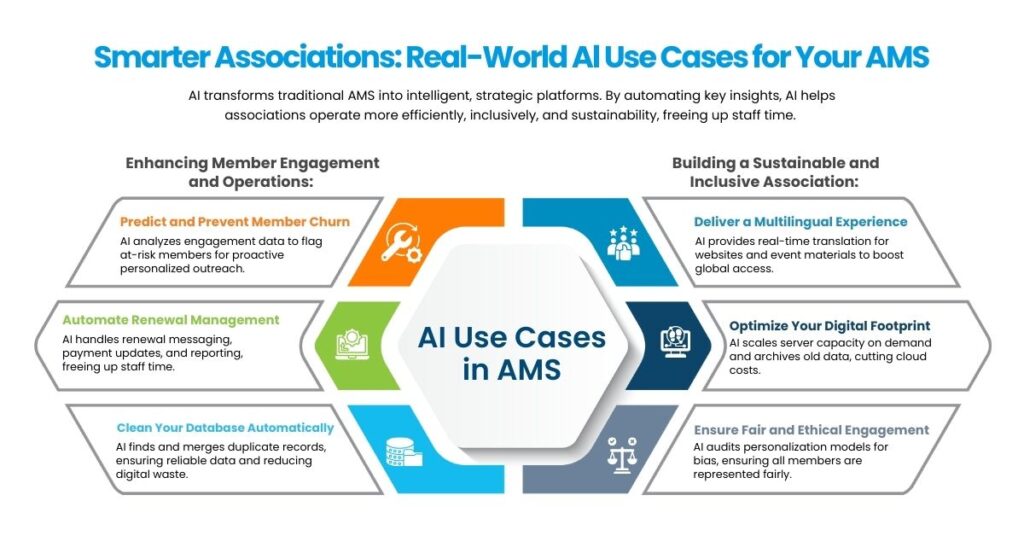
Here’s how AI helps cut waste and increases efficiency:
Predictive Analytics
AI can identify patterns in member behavior leading to predictions related to member churn or event attendance. With these AI predictions, you can take early actions such as sending a personalized message to a member on the verge of lapse, or reminder emails to event attendees.
Use Case: Member Churn Anticipation & Retention Intervention
Using AI, email interactions, login frequency, event attendance, and historical renewal habits are analyzed to flag those who will eventually lapse. The AMS automatically triggers personalized outreach, reminding members about value tailored to them or follow-up from staff, that improves retention while reducing manual effort.
Automation of Repetitive Tasks
AI can speed up processes like sending emails, updating profiles, or generating reports, with greater accuracy. That means your team can focus on strategy instead of admin work.
Use Case: Intelligent Renewal Management
AI enables the automation of renewal messaging, the scheduling of reminders based on a history of a member’s engagements, instantaneous updates of their membership status upon payment, and the creation of real-time renewal dashboards. The staff stays focused on strategy while the system executes routine workflows, consistent and error-free.
Data Cleaning and Optimization
AI-powered tools can detect duplicate records, eliminate errors, and maintain your database clean. This reduces digital clutter and enhances reporting accuracy while reinforcing your data lifecycle management strategy.
Use Case: Automating Duplicate Record Resolution
AI automatically searches the AMS for duplicates based on e-mails, phone numbers, organization name, and event check-ins, merges them automatically in cases where matches are clear, and flags records with uncertainty for human review. This cleans the data and makes the database reliable while reducing waste in storage.
AI’s Role in Accessibility and Inclusion
Beyond environmental sustainability, AMS sustainability also includes making systems more inclusive. AI can make AMS platforms more accessible to people with disabilities, non-native speakers, and the less technologically capable.
Conversational Interfaces
AI-powered chatbots and voice assistants make the interactions with your AMS a lot easier for the users, even if they’re not tech-savvy.
Real-time Translation
Multilingual support extends outreach of your content and services to members from diverse backgrounds.
Personalized Experiences
The application of AI allows the platform to personalize contents and routes of navigation, so as to be even more intuitive and user-friendly. This directly contributes to member experience personalization, a core driver of engagement and satisfaction.
Use Case: AI Multilingual Experience Layer
AI provides translations in real time for websites, learning content, event materials, and even community discussions so that members can interact in their own native language. This extends access, increases international contribution, and reduces reliance on human translation efforts.
Sustainability in IT Infrastructure and Operations
AI supports IT teams in optimizing infrastructure, automating resource management, and driving scalable remote-first environments—all essential to AMS sustainability and lowering digital carbon footprints.
Cloud Resource Optimization
AI algorithms dynamically allocate compute and storage resources based on real-time demand.
Use Case: Dynamic Infrastructure Scaling
AI automatically scales up the server capacity during peaks-like event registrations-and reduces it during off-peak hours. This minimizes the idle compute time that reduces cloud costs and supports greener digital operations without compromising the performance.
Data Lifecycle Management
AI helps identify redundant, obsolete, or trivial data and automates processes for archiving and deletion.
Use Case: Intelligent Archival of ROT Data
AI categorizes obsolete recordings, older e-mail campaigns, and obsolete documents to allow automatic archiving or removal based on policy. This cuts storage needs, reduces backup loads, and ensures sustainable long-term data governance.
Remote Collaboration Enablement
AI-enabled platforms also provide distributed teams with improved communication, scheduling, and collaboration capabilities.
Use Case: Smart Meeting & Workflow Coordination
AI analyzes team schedules, time zones, and workload patterns to recommend ideal meeting times. Based on the same, it generates summaries, extracts action items, and creates searchable notes to streamline operations for hybrid and remote teams.
Event Sustainability Optimization
Use Case: Hybrid Format Optimization
AI compares past attendance, travel data, and member preferences, and then estimates the carbon impact to recommend which sessions should be virtual, hybrid, or in-person. This will ensure strong engagement while meaningfully reducing travel-related emissions.
Ethical AI
For how powerful AI is, it must be deployed responsibly. Associations have to contemplate ethical issues, such as data privacy, algorithmic bias, and transparency. Complying with the regulations such as GDPR is a must. Audit for bias in data and decision-making, training to staff to ensure that AI is used in ethical and effective ways cannot be compromised.
Use Case: Engagement Model Bias Detection
AI checks the personalization models for latent bias in under-representing certain regions or demographics in the recommended events. Additionally, the system flags issues, provides solutions to rectify the same, and cultivates fairness and transparency in the engagement of the members.
Final Thoughts
AI in AMS is not only about innovating but doing more with less and for all. Associations can cut off their wasteful processes, increase accessibility, and adopt digital sustainability to build strong resilient communities. As AI continues to evolve, this sets up associations in a special position as examples of how to use technology ethically, inclusively, and with sustainability.
AuthorBio
Chirag Rathi, Technical Lead, Aplusify
Chirag is a Salesforce Techno-Functional Consultant and Technical Lead with over 5+ years of experience delivering scalable CRM solutions across Sales, Service, and custom cloud implementations. He specializes in Salesforce Flow automation, integrations, data architecture, and low-code solution design. Chirag has a strong track record of leading cross-functional teams, managing end-to-end project deliveries, and translating complex business requirements into robust technical solutions. He is a 4X Salesforce Certified professional, including Data Architect, with hands-on experience in AppExchange product development and enterprise-grade integrations.