
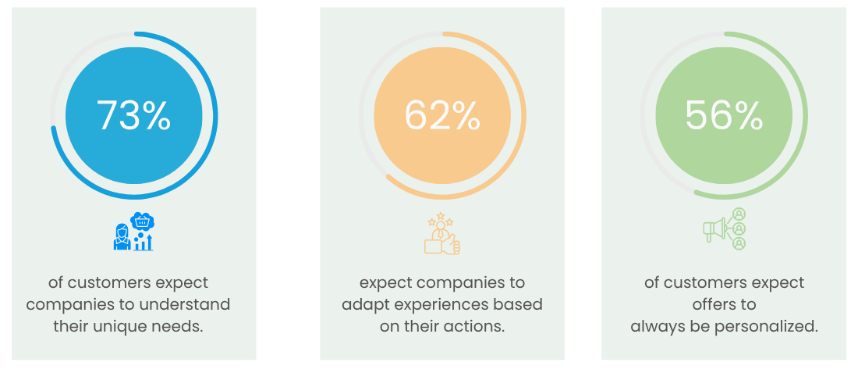
For decades, the “blast” email was the crown jewel of association communication. It was efficient, cost-effective, and reached every member simultaneously. However, in an era defined by Netflix recommendations and Amazon’s predictive algorithms, the “one-size-fits- all” approach isn’t just outdated—it’s actively eroding member loyalty. According to Salesforce’s State of the Connected Customer report, a staggering 73% of customers expect companies to understand their unique needs and expectations.
Modern members don’t just want relevant content; they expect it as a baseline. They are navigating an attention economy where every brand is vying for their limited bandwidth. If your association continues to send general updates that don’t align with a member’s specific career stage, geographic location, or technical interest, your emails will move from the “Inbox” to the “Trash” with increasing speed. Transitioning to hyper-personalization is no longer a luxury; it is a survival mandate.
Phase 1: Breaking the “Batch and Blast” Mindset
The journey begins with a fundamental shift in how we view the member relationship. Precision is the ultimate multiplier of impact. Hyper-personalization moves the conversation beyond “Hello [First_Name]” to a contextual dialogue.
Key Insight: A “Digital Ethics” session attendee doesn’t just need more emails about ethics; they need a curated path that includes peer-reviewed studies, upcoming webinars, and networking circles related to that specific interest.
The Strategy of Intentionality: Associations must stop viewing members as a monolithic “database” and start viewing them as a collection of unique professional trajectories. This requires shifting from demographic targeting (who they are) to behavioral targeting (what they do).
Phase 2: Solving the “Data Silo” Crisis
The primary hurdle for most associations is the existence of disconnected data. Membership data lives in an AMS, event data in a separate registration tool, and engagement metrics in an email service provider.
To achieve hyper-personalization, you must build a Single Source of Truth (SSOT).
- API Integration: Ensure your AMS and Marketing Automation platforms share data in real-time.
- Data Governance: Establish “clean data” protocols. If your data is messy, your personalization will be inaccurate, which is often worse than no personalization at all.
- The 360-Degree View: Salesforce research highlights that 78% of customers expect consistent interactions across departments. When a member calls support, the agent should see their recent website activity and event attendance immediately.
Phase 3: The Privacy Paradox and First-Party Data
As we move toward hyper-personalization, we must address the “Privacy Paradox.” Members want personalization, but they are increasingly wary of how their data is tracked.
Strategy: The Value Exchange
Associations are in a unique position to win this battle through First-Party and Zero-Party data.
- Zero-Party Data: Information a member intentionally shares (e.g., preference center selections).
- First-Party Data: Information gathered from their actions (e.g., links clicked, resources downloaded).
By being transparent about data usage and showing immediate value (e.g., “We are asking for your specialty so we can filter out irrelevant news”), you build a foundation of trust that commercial brands often struggle to replicate.
Phase 4: Moving from Segments to Adaptive Journeys
Once your data is unified, the roadmap moves from broad segmentation (e.g., “All Student Members”) to individual 1-to-1 journeys.
- The Onboarding Journey: Instead of one “Welcome” email, a new member receives a sequence that adapts. If they click a link about “Certifications,” the next email in the sequence focuses on exam prep, not the annual conference.
- The “At-Risk” Journey: If a member hasn’t logged into the portal for 90 days, an automated, personalized check-in is triggered, offering a resource related to their last known interest.
The Renewal Journey: Move away from “Your dues are late” to a Personalized Impact Report. Show them exactly how many credits they earned, how many articles they read, and the estimated ROI of their membership.
Phase 5: Overcoming the “Content Gap”
One of the most significant, yet rarely discussed, hurdles in hyper-personalization is the sheer volume of content required. If you move from one “blast” email to five distinct member journeys, you have quintupled your content needs overnight. This is where many associations stall.
The Strategy: Modular Content Architecture
To scale, associations must move away from creating “static” newsletters and toward modular content.
- Content Atomization: Break down long-form reports or magazine articles into “atoms”—short tips, video snippets, or infographics.
- Dynamic Content Blocks: Instead of building ten different emails, use one template with dynamic blocks. A mid-career professional sees a “Leadership Workshop” banner, while a student member sees an “Internship Board” link in the exact same email layout.
- User-Generated Wisdom: Leverage your community forums. High-engagement threads can be automated into “Best of the Week” digests tailored specifically to the topics a member follows.
Phase 6: Operationalizing the Shift (Culture & Skills)
Hyper-personalization is as much a cultural challenge as it is a technical one. For years, association departments have operated in vacuums: Marketing handles the emails, Education handles the webinars, and Membership handles the renewals.
Breaking the Internal Silos:
To succeed, the organization must adopt a “Member-Centric” Operating Model.
- Cross-Functional Squads: Form a “Member Experience” task force that includes stakeholders from IT, Marketing, and Member Services. Their goal isn’t to hit departmental KPIs, but to optimize the “Total Member Journey.”
- Upskilling the Team: Your staff may need to move from being “Email Specialists” to “Marketing Technologists.” This involves understanding data hygiene, logic-based branching, and basic analytics to interpret what the data is actually telling them.
Phase 7: The Measurement of Success (New KPIs)
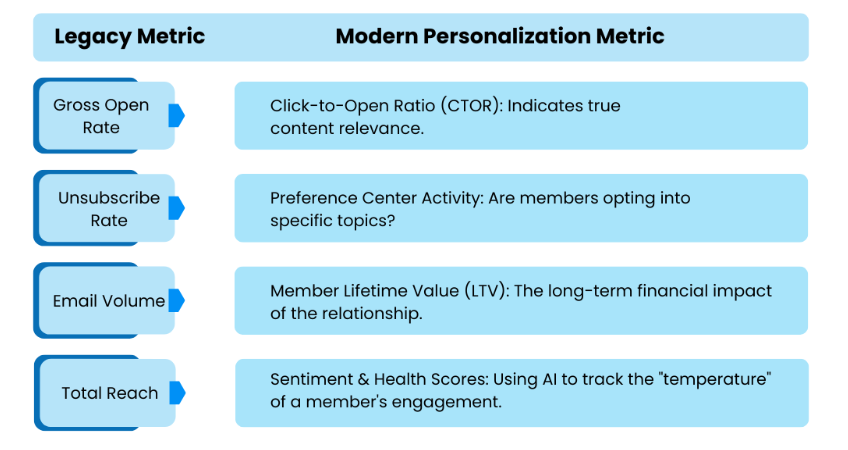
You cannot measure the success of hyper-personalization using the metrics of the “Batch and Blast” era. Open rates are increasingly unreliable due to privacy changes (like Apple’s Mail Privacy Protection). Instead, modern associations must look at Downstream Engagement Metrics.
The Ethics of Personalization
As associations, you hold a position of “Trusted Advisor.” This comes with a responsibility to use data ethically. Hyper-personalization should never feel like surveillance; it should feel like anticipatory service.
The goal is to move from “We know what you did” to “We know what you need to succeed.” When a member feels that their association is actively curating a path for their professional growth, the question of “Is the membership worth the dues?” disappears. It is replaced by a sense of belonging to a community that truly “gets” them.
Conclusion: The First 90 Days
Transitioning to this roadmap doesn’t happen overnight. It begins with a Pilot Program. Choose one specific segment—perhaps your “New Professionals” or “Members within 6 months of Lapse”—and apply the hyper-personalization framework to them first.
Document the wins, learn from the data friction, and use those insights to fuel the rollout for the rest of your membership. The shift from mass communication to meaningful connection is the single most important investment your association will make this decade.
Strategic Follow-up
As you look at your current member database, which specific sub-group would benefit most from a personalized journey right now—your newest members, or those who haven’t engaged in over a year?
AuthorBio
Sukanya Deb, Business Development Manager, Aplusify
Meet Sukanya Deb, a seasoned sales professional with over a decade of experience spanning enterprise software, AI-driven analytics, and IT consulting. As part of Aplusify, she helps associations and nonprofits align their goals with the right technologies, like Salesforce, Fonteva, and other Salesforce-based solutions, to drive measurable outcomes across IT, membership, events, and analytics. Always eager to collaborate, Sukanya welcomes meaningful connections.