
As associations and nonprofits explore advanced automation, agentic AI promises a new level of intelligent decision-making. Unlike traditional AI, which executes tasks, agentic AI observes, decides, acts, and escalates. But these systems rely on clean, structured, and complete data. Without proper preparation, even the smartest AI struggles to deliver meaningful outcomes.
This blog explores what readiness looks like, how organizations can assess their CRM, AMS, or data stack, and practical steps to prepare for successful agentic AI adoption.
The Importance of Data Readiness for Agentic AI
Before implementing agentic AI, the foundation must be solid. High-quality data and clear processes are the starting point. Agentic systems need reliable inputs to make informed decisions that support members, donors, and volunteers without constant supervision.
Without readiness, agentic AI can misfire, produce inconsistent results, and increase operational strain rather than reduce it. Data readiness is essential to realizing the full potential of intelligent automation.
Understanding Data Readiness
Reliable data is the backbone of agentic AI. Without accurate, consistent, complete, and relevant information, the system cannot observe trends, make decisions, or act effectively. These four qualities allow AI to operate confidently and reduce the need for constant human intervention.
- Accuracy: All member, donor, and volunteer records should be correct and current. Incorrect names, emails, or membership statuses can cause AI to act on faulty assumptions.
- Consistency: Formats for dates, phone numbers, and other key fields should follow the same standards across systems.
- Completeness: Missing donation histories, event attendance, or engagement signals limit the AI’s ability to detect trends or make meaningful suggestions.
- Relevance: Include behavioral signals that matter for engagement, retention, and operations, like last login, last donation, or program participation.
Assessing Your CRM, AMS, and Data Stack
Evaluating the readiness of your technology stack is critical. Systems must not only hold data but make it actionable and connected across workflows. Agentic AI thrives when it can move seamlessly between CRM, AMS, and other platforms to coordinate tasks.
Key Questions to Consider
Identifying gaps starts with asking clear questions. These questions help organizations evaluate integration, data health, workflow clarity, and escalation practices before introducing agentic AI.
- Integration: Are your CRM and AMS connected, or do staff spend hours manually transferring data?
- Data Health: Are duplicate or outdated records cleaned up? Are key fields standardized?
- Workflow Coverage: Are core processes, like renewals, donations, or event registrations, mapped end-to-end?
- Escalation Points: Are exceptions clearly defined so AI knows when to act independently and when to involve staff?
Common Gaps That Undermine Readiness
Even organizations with sophisticated tech stacks can face readiness challenges. These gaps prevent agentic AI from operating efficiently and may increase staff effort rather than reduce it.
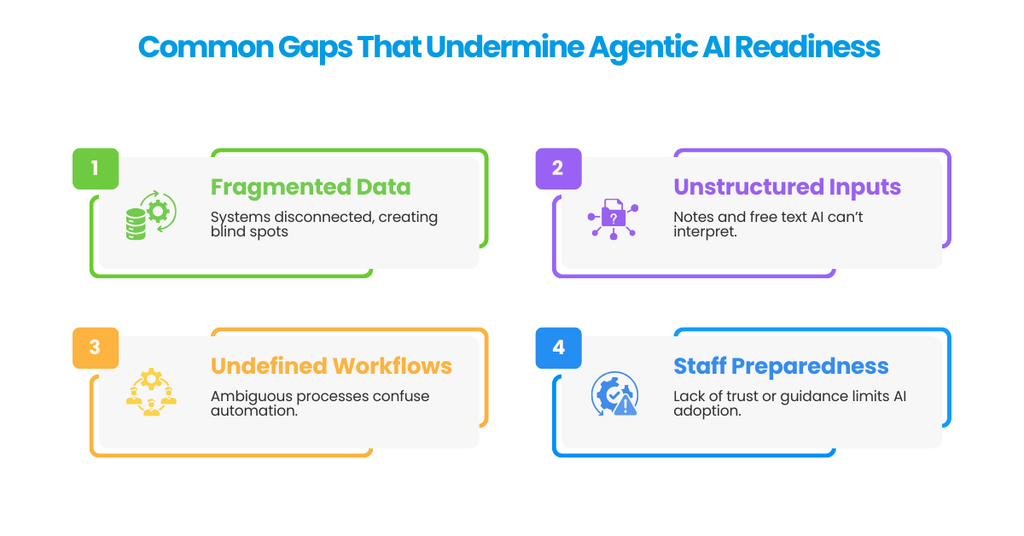
- Fragmented Data: Information stored across multiple systems without clear connections.
- Unstructured Inputs: Notes, free-text fields, or inconsistent formats that AI cannot interpret reliably.
- Undefined Workflows: Ambiguous processes leave AI without clear rules or escalation paths.
- Staff Preparedness: Teams unsure of how to trust or verify AI recommendations may override automation unnecessarily.
Practical Steps to Prepare for Agentic AI
Readiness requires both technical work and organizational planning. The following steps make it possible for agentic AI to act autonomously while staying aligned with mission goals.
Data Clean-Up and Standardization
Clean and standardized data allows agentic AI to act with confidence. Addressing duplicates, missing information, and inconsistent formats ensures the system can observe, decide, and act reliably.
- Audit Records: Identify duplicates, outdated information, and missing fields across all platforms.
- Standardize Formats: Align dates, phone numbers, and membership categories.
- Add Behavioral Signals: Include engagement metrics like last login, donations, event participation, and survey responses.
- Maintain Data Hygiene: Schedule regular clean-ups to prevent decay over time.
Workflow Mapping and Guardrails
Defining workflows and guardrails gives agentic AI a clear path to act safely. Without well-mapped processes and escalation rules, AI may hesitate, act incorrectly, or overload staff with exceptions.
- Map Key Journeys: Define member and donor interactions from onboarding to renewal or donation lifecycle.
- Identify Automatable Actions: Specify tasks AI can safely execute, such as reminder emails or low-stakes notifications.
- Set Escalation Rules: Define clear thresholds for when AI should involve human staff, for example, high-value donors, complex member cases, or unusual behavior.
- Document Processes: Keep instructions explicit so both staff and AI understand expectations.
Staff Training and Adoption
Staff readiness is as important as technical readiness. Teams must understand AI capabilities and how to verify or override decisions. Education and feedback loops foster trust and proper adoption.
- Educate Teams: Teach staff how agentic AI makes decisions, what actions it takes, and how to review escalations.
- Feedback Loops: Encourage staff to provide input when AI actions are inconsistent or unexpected.
- Shift Focus: Help teams move from routine monitoring to strategic oversight and relationship-building.
Real-World Examples of Agentic AI in Action
Concrete examples illustrate how readiness translates to operational impact. Each scenario shows how agentic AI observes, decides, acts, and escalates intelligently.
Membership Engagement
Effective AI begins with reliable engagement data. Observing behavior, making informed decisions, and acting autonomously improves member interactions while reducing manual effort.
- Observe: Agentic AI monitors login frequency and past event participation.
- Decide: The system identifies members at risk of disengagement.
- Act: Personalized invitations are sent automatically, tailored to interests and past activity.
- Escalate: High-value members are flagged for personal outreach by staff.
Donation and Fundraising Optimization
Agentic AI can streamline fundraising operations by prioritizing high-potential donors and executing targeted actions, freeing staff for relationship-building.
- Observe: The AI tracks donation patterns and time since last contribution.
- Decide: It prioritizes members most likely to respond.
- Act: Automated nudges are sent, and recurring donation options are presented.
- Escalate: Prospects with high potential are routed to fundraising staff.
Event Coordination
AI improves event management by identifying engagement gaps and automating outreach, ensuring attendance without overloading staff.
- Observe: AI monitors registration trends and email engagement.
- Decide: Identify attendees who need reminders or incentives.
- Act: Automated reminders are sent with personalized content.
- Escalate: VIP or key sponsors are flagged for manual follow-up.
Understanding Costs and Constraints
Implementing agentic AI requires realistic planning. Organizations must account for investment, timeline, and cultural change to avoid surprises.
- Investment: May include AI-ready platforms, integration tools, and short-term consulting.
- Timeline: Preparing data, defining workflows, and training staff can take 4–12 weeks for medium-sized organizations.
- Cultural Shift: Teams must learn to trust AI recommendations and adjust workflows to leverage automation fully.
Measuring Success and Next Steps
Successful agentic AI adoption is measurable. Indicators like clean data, reduced manual intervention, and improved outcomes show readiness and long-term impact.
- Data Accuracy: Fewer duplicates, missing records, and consistent formatting.
- Automation Adoption: Staff increasingly rely on AI for routine tasks.
- Reduced Manual Intervention: Fewer escalations for routine processes.
- Improved Outcomes: Engagement, retention, and fundraising metrics show measurable improvement.
Conclusion
Agentic AI transforms operations but requires readiness. Clean data, defined workflows, and trained staff make AI reliable. When properly prepared, CRM, AMS, and data stacks allow agentic AI to reduce operational strain, improve engagement, and support mission-focused outcomes.
At Aplusify, technology works quietly in the background. Teams can focus on programs, members, and growth. Prepared stacks and thoughtful adoption turn agentic AI into a dependable partner, not a source of additional work.
AuthorBio
Akanksha Negi, Technical Content Writer, Aplusify
With a wealth of experience in content strategy, copywriting, and marketing, Akanksha is an expert in creating clear, compelling content that resonates with audiences. She excels at translating complex, Salesforce-based technical concepts into simple, effective messaging. At Aplusify, she leads content initiatives that drive clarity, build strong connections, and maintain consistency across all communication channels.