
Artificial intelligence now plays a visible role in how organizations operate. Reporting, data analysis, and routine workflows increasingly rely on automated systems to maintain speed and consistency at scale. For many teams, this shift has delivered tangible efficiency gains. Yet as operations become more interconnected and expectations rise, automation alone is proving insufficient. Executing tasks faster does not always translate into meaningful progress.
This gap highlights an important distinction. Traditional AI focuses on completing predefined tasks efficiently. Agentic AI focuses on advancing work toward outcomes adapting to context, prioritizing actions, and coordinating across systems. For organizations balancing limited staff capacity with expanding responsibilities, understanding this difference is critical. The future of operational effectiveness depends not just on automation, but on intelligence that can move work forward.
The Automation Ceiling: Why Traditional AI Is Reaching Its Limits
Automation has helped organizations streamline work, but its benefits tend to plateau as environments become more dynamic. Many teams eventually reach a point where adding automation no longer reduces effort and may even increase oversight.
This is not a failure of automation itself; it is a signal that operational needs have changed.
Efficiency Without Adaptability
Traditional AI continues to play an important role in modern operations. Its strengths are proven and often essential. At the same time, its limits explain why many organizations still feel operational strain despite increased automation.
Strengths That Still Matter
Traditional AI delivers consistent value in areas where predictability and repetition matter most:
- Reliably executes rule-based, repetitive tasks such as data entry, notifications, and scheduled reporting
- Improves speed and consistency across standardized workflows
- Supports analysis through pattern detection, forecasting, and alerts
- Provides early signals that help teams monitor trends and plan ahead
For many organizations, these capabilities form the backbone of digital operations.
Limitations That Slow Progress
As operations become more interconnected, traditional AI begins to show clear constraints:
- Operates within fixed workflows and predefined rules
- Lacks awareness of downstream impacts across systems
- Requires manual intervention when exceptions occur
- Struggles to adapt when conditions change or priorities shift
- Increases staff effort as tools multiply and handoffs grow
Automation reduces effort within individual tasks. Coordination, judgment, and exception handling still depend heavily on human involvement.
What Is Agentic AI? From Task Execution to Outcome Ownership
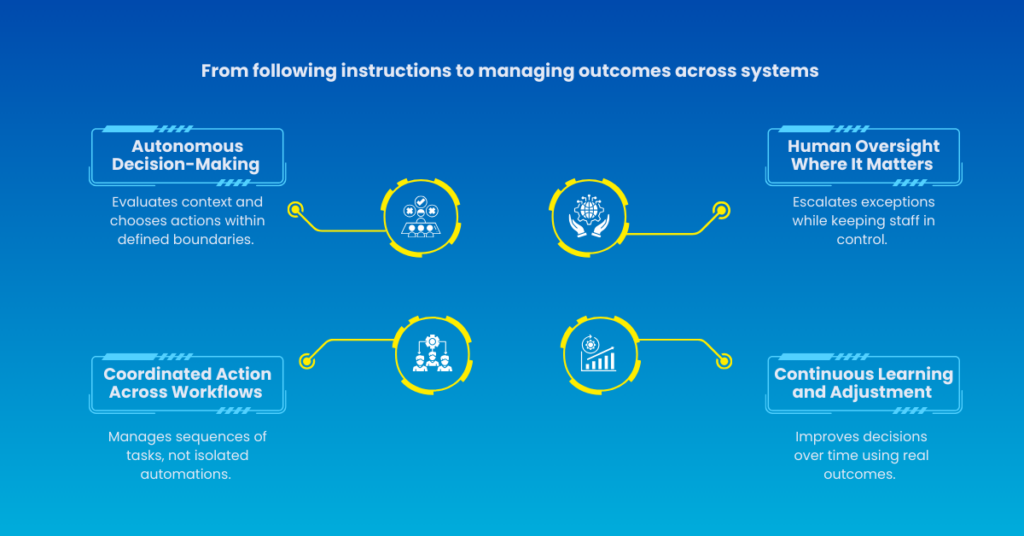
Agentic AI represents a shift in how systems behave. Instead of waiting for instructions, agentic systems evaluate context, select actions, and adjust based on results. This approach changes the role of technology from executor to collaborator.
Agentic AI vs Traditional AI: Differences That Actually Matter
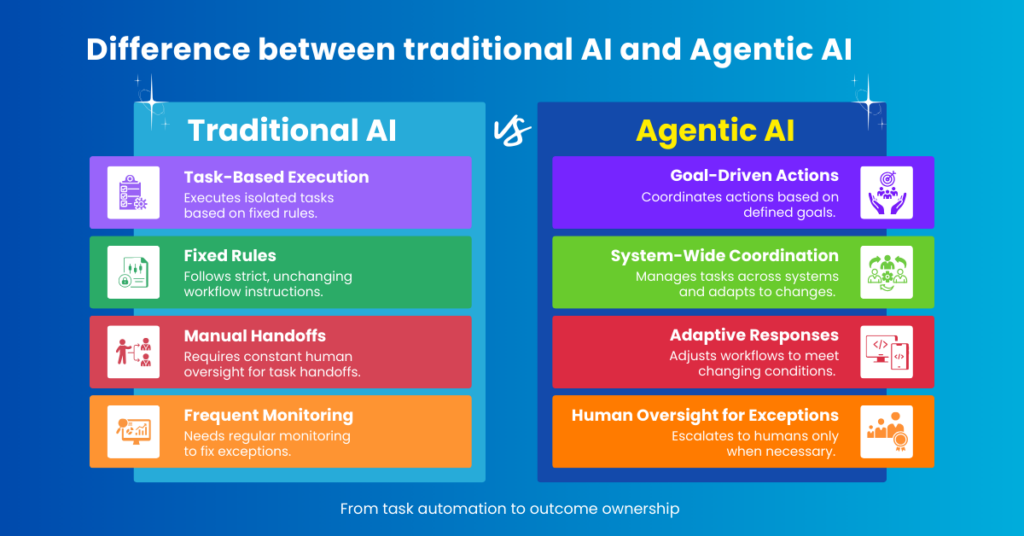
Traditional AI executes isolated tasks based on fixed rules. Agentic AI coordinates actions across systems, adapts to goals, and keeps work moving when conditions change. The shift replaces constant oversight with steady progress and operational confidence.
Why Modern Organizations Need Systems That Can Decide, Not Just Execute
As organizations grow, the number of decisions multiplies faster than staff capacity. Teams cannot manually coordinate every exception, dependency, and adjustment without strain, and decision-making often becomes the bottleneck that slows operations.
Managing Growth Without Adding Strain
Modern operations depend on connected platforms and shared data. Manual coordination introduces delays, increases fatigue, and creates gaps in execution. Agentic AI absorbs part of this decision load by evaluating context continuously and taking action in real time, all within established rules. This allows operations to expand without requiring constant human intervention.
Supporting Strategic Focus
When routine decisions are managed by agentic systems, staff can devote more time to higher-value work. Planning becomes sharper, service delivery improves, and long-term goals remain clear. Technology shifts from being a constraint to an active enabler of the organization’s mission.
What the Shift to Agentic AI Means for Teams, Leaders, and Operations
Moving toward agentic AI reshapes daily work. It affects how teams operate, how leaders plan, and how organizations measure impact.
Reduced Operational Load for Teams
Fewer manual decisions reduce interruptions and exceptions. Teams spend less time managing systems and more time delivering programs, resulting in steadier workflows and better use of capacity.
Clearer Insight for Leadership
Leaders gain visibility into outcomes rather than task volume. Reporting centers on progress, risk, and results and decision-making becomes proactive instead of reactive.
Stronger Alignment with Mission
Systems built around outcomes reinforce organizational purpose. Operations support impact rather than distract from it. This alignment supports long-term stability and growth.
Systems designed to focus on outcomes help operations actively support the organization’s mission. Workflows reinforce impact instead of creating distractions, which strengthens alignment across teams and lays the foundation for long-term stability and sustainable growth.
Conclusion
Automation transformed execution. Agentic AI transforms ownership. Traditional AI remains valuable, but it cannot carry modern operations alone. Systems that can decide, adapt, and learn to reduce operational strain and support sustainable growth.
At Aplusify, the focus remains steady. Technology should work quietly in the background so teams can focus on members, programs, and missions. When systems operate intelligently and reliably, organizations move forward with confidence and clarity.
AuthorBio
Akanksha Negi, Technical Content Writer, Aplusify
With a wealth of experience in content strategy, copywriting, and marketing, Akanksha is an expert in creating clear, compelling content that resonates with audiences. She excels at translating complex, Salesforce-based technical concepts into simple, effective messaging. At Aplusify, she leads content initiatives that drive clarity, build strong connections, and maintain consistency across all communication channels.