
Nonprofit staff routinely spend over 30% of their working hours on manual, repetitive administrative labor. From cross-referencing donor records to writing personalized grant updates and drafting board onboarding materials, operational overhead consistently drains capacity away from core mission delivery.
While mainstream artificial intelligence solutions have transformed commercial sectors, purpose-built tools designed around the operational realities of mission-driven teams have been slow to emerge.
That dynamic shifted significantly with Anthropic’s expansion of Claude for Nonprofits—a dedicated initiative introducing specialized plugins tailored directly for fundraising, marketing, and human resources workflows.
Over 25,000 nonprofits already rely on Claude, with the vast majority consisting of small, local teams operating under tight resource constraints. By co-designing this new plugin alongside ~30 active nonprofit organizations, Anthropic has signaled a major shift: AI is moving from generic conversational text generation into deep, contextual, mission-focused automation.
At Aplusify, as a specialized Salesforce partner for nonprofits and associations, we closely evaluate how new AI integrations impact technology ecosystems, data architecture, and operational scalability. Here is a breakdown of what Anthropic’s latest update brings to the table, how it impacts your organization’s capacity building, and how to safely adopt these tools without compromising organizational data.
What’s New in the Claude for Nonprofits Expansion?
Available to verified nonprofits on Team and Enterprise plans, the expanded Claude for Nonprofits environment introduces a dedicated suite of core skills across four vital operational pillars:
1. Funder Research & Grant Proposal Drafting
Finding grant opportunities aligned with your mission demands hours of manual research and custom drafting. The new capabilities streamline this process end-to-end:
- Rapidly researching prospective funders, foundations, and institutional grant guidelines.
- Generating initial drafts for complex grant applications, continuous progress reports, and customized donor update communications.
- Reformatting dynamic outcome metrics into distinct formats required by different reporting bodies.
2. Marketing Campaign Planning & Quality Control
Small marketing teams often struggle to maintain multi-channel outreach while maintaining brand consistency:
- Brainstorming, outlining, and building full campaign calendars across social, email, and web channels.
- Reviewing drafts and collateral for tone, clarity, accessibility, and alignment before assets go live.
- Repurposing long-form content (like annual reports or whitepapers) into bitesize engagement pieces.
3. Recruitment, Staff Hiring & Board Onboarding
Human resources in smaller nonprofits frequently fall on executive directors or operations managers:
- Drafting job descriptions, interview scorecards, and standardized candidate communications.
- Building structured onboarding roadmaps for incoming staff members.
- Automating outreach workflows to identify and recruit active, engaged board members.
Recurring Donations
With NPSP recurring gifts, each installment is used to create individual Opportunities in accordance with the installment schedule. Nonprofit Cloud keeps the amount that a donor had promised to give separate from the amount they actually paid by using Gift Commitments and Gift Transactions.
Before carrying out the migration, check the active and historical schedules, the frequencies of the payments, the payment methods, the failed transactions, and the automated receipts. The existence of a recurring record in the new environment does not mean that your automated processing is working correctly.
4. Grounded, Responsible AI Configuration
Crucially, the plugin emphasizes safety and context. It equips teams to configure Claude using their own internal organizational records, voice guidelines, and corporate AI policies—preventing generic “hallucinated” outputs and keeping communications true to brand values.
Beyond Software: The Human Capital Push (Claude Corps & Taproot)
Technology tools alone do not build operational capacity; organizations need the skilled human talent to implement them effectively. Anthropic’s announcement pairs platform capabilities with direct talent investments:
- Claude Corps: Placed 1,000 early-career fellows directly into US-based nonprofits to accelerate digital transformation and day-to-day implementation.
- Taproot Partnership: A planned collaboration with Taproot Foundation to connect nonprofits with pro bono corporate tech consultants for shorter, project-based assignments.
This combination of specialized software and hands-on consulting support addresses the exact talent bottleneck that keeps small-to-midsize nonprofits from adopting modern technology.
The Strategic Perspective: Integrating AI into Your Core Tech Stack
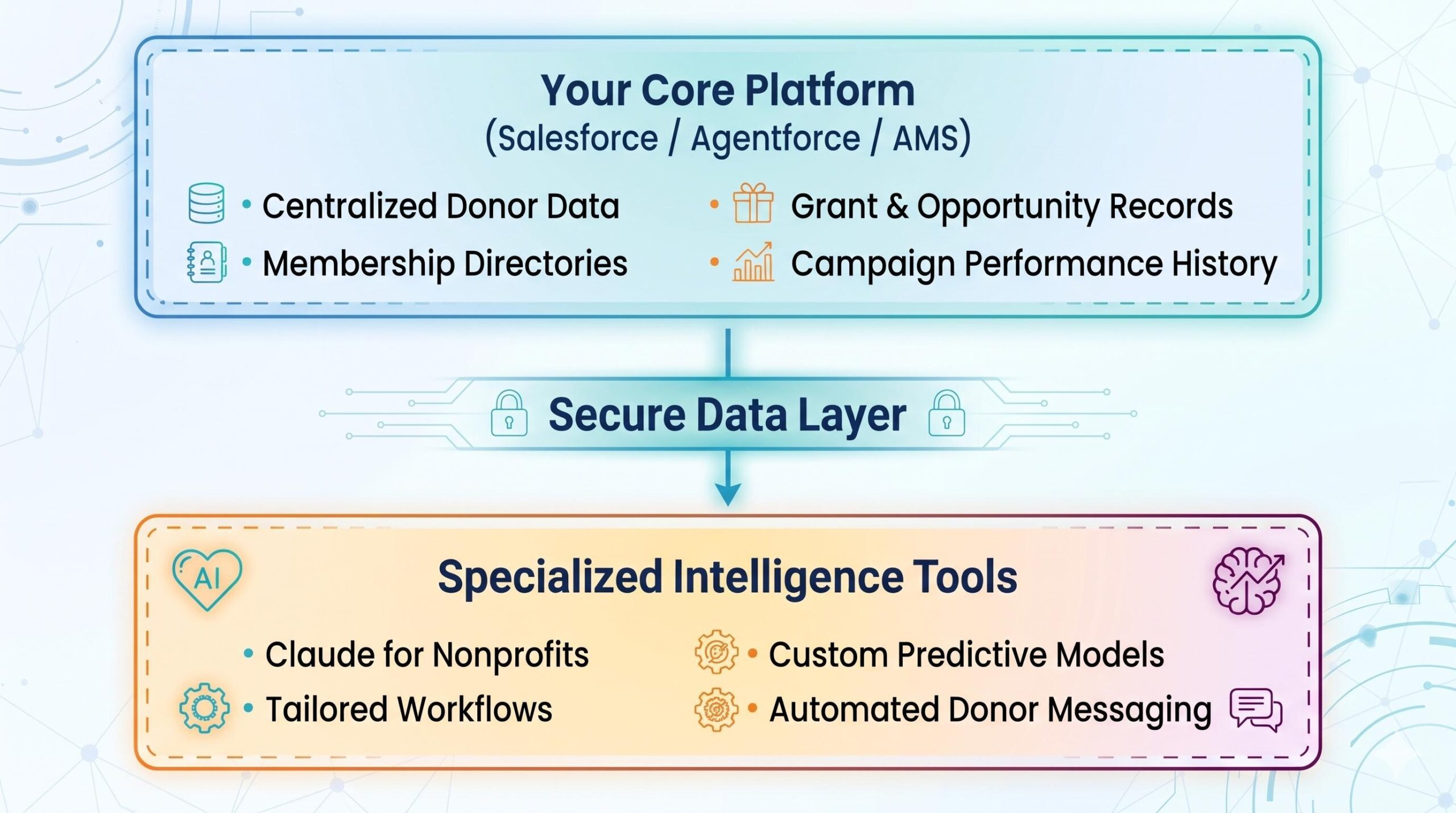
While stand-alone AI tools deliver quick wins for drafting copy or organizing thoughts, their long-term value depends on how seamlessly they interact with your core system of record—such as your CRM (Salesforce Nonprofit Cloud / Agentforce), AMS (Fonteva, Nimble), or financial platform.
Why Data Grounding Matters
AI models produce their highest-value outputs when supplied with clean, structured, first-party data. If your organization’s CRM contains outdated donor logs, duplicate contact profiles, or incomplete grant histories, AI outputs will remain generic or inaccurate.
To maximize tools like Claude for Nonprofits:
- Clean Your Data First: Ensure donor records, grant milestones, and interaction logs in your CRM are consolidated and accurate.
- Define Standard Operating Procedures: Establish clear protocols for how staff query AI tools and verify generated outputs before sending donor communications or submitting grant materials.
- Establish AI Governance: Implement explicit guidelines governing data privacy, secure record handling, and staff usage limits.
Step-by-Step Roadmap: Preparing Your Team for AI Adoption
Transitioning your nonprofit to AI-assisted workflows requires a methodical approach.
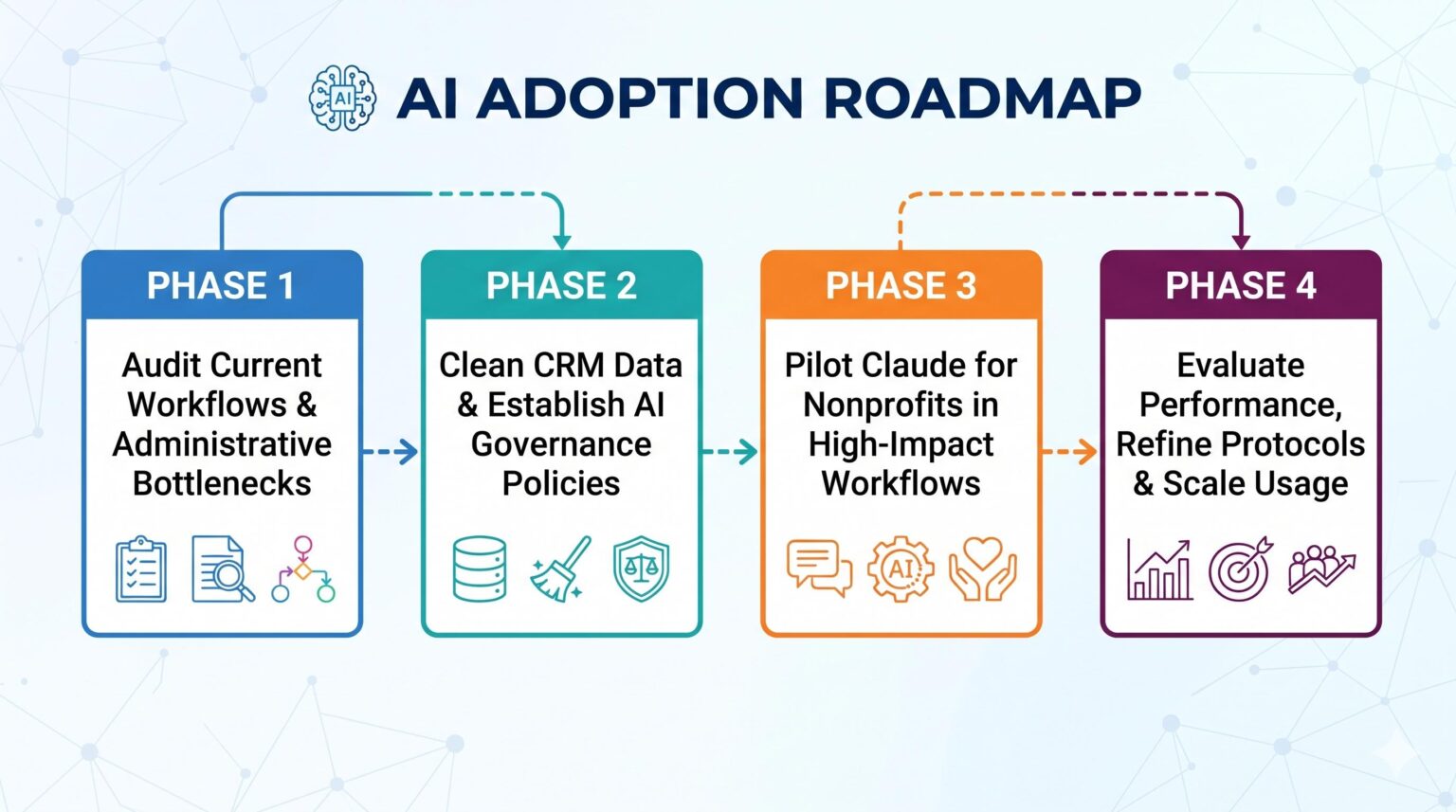
- Audit Administrative Bottlenecks: Identify time-consuming tasks (e.g., writing donor acknowledgment letters, drafting preliminary grant sections, or building board packages) that pull team members away from direct program delivery.
- Standardize Brand & Policy Documents: Gather your style guide, tone-of-voice documentation, past successful grant proposals, and organizational policies. Feeding consistent context into Claude ensures tailored responses.
- Pilot High-Impact Use Cases: Start with a focused pilot—such as generating initial drafts of donor updates or drafting staff onboarding schedules. Measure time saved and output quality before scaling across departments.
- Train & Empower Staff: Frame AI as an assistant rather than a replacement. Focus staff training on prompt engineering, critical evaluation of generated drafts, and ethical data handling.
Conclusion: Scaling Mission Impact with Smart Technology
The expansion of Claude for Nonprofits reflects a broader shift across the technology ecosystem: artificial intelligence is becoming purpose-built, accessible, and deeply integrated into daily workflows. By combining tailored AI plugins with pro bono human talent initiatives, small and midsize mission-driven organizations can now access capacity that was previously out of reach.
At Aplusify, we help nonprofits and associations optimize their core digital infrastructure, secure their data environments, and integrate modern AI automation safely into their ecosystem. Whether you are evaluating new AI platforms or optimizing your Salesforce foundation to support advanced integrations, taking a deliberate, data-first approach ensures your technology investments directly amplify your mission.
Author Bio
- Preeti Deepa Dash
- Marketing Operations and Revenue Expert, Aplusify
Preeti Dash is a marketing professional at Aplusify with 7 years of experience in technology marketing and communications. She works closely with associations and nonprofits to simplify the value of Salesforce and AMS solutions through strategic storytelling and educational initiatives, helping organizations navigate digital transformation and enhance member engagement.