
Choosing Fonteva is a major step toward building a more connected, scalable, and member-centric future. But selecting the platform is only part of the decision. The pricing model behind the implementation can have just as much impact on the success of the project.
For associations, Fonteva implementations often involve far more than system setup. They usually include membership lifecycle configuration, events, payments, integrations, legacy data migration, reporting, digital experiences, analytics and AI readiness. That means the implementation approach needs to be not only technically sound, but also financially predictable.
This is where the difference between a firm fixed-cost model and a time-and-materials engagement model becomes important. A time-and-materials approach may appear flexible at the beginning, but that flexibility often comes with uncertainty. A more strategic alternative is a firm-fixed-cost Fonteva implementation model for an agreed-upon scope—one that brings cost predictability, stronger governance, and better delivery discipline.

Hidden Financial Risks of the Time-and-Materials Engagement Model
Transitioning to a new AMS involves more than just technical hurdles; it introduces significant financial vulnerabilities if the contract structure is loose. A time-and-materials engagement model can work in certain advisory or open-ended situations, but for a structured AMS implementation, it often introduces avoidable risk.
Without a fixed-cost framework, associations often find themselves trapped by these four hidden risks that can jeopardize both the budget and the project’s long-term viability.
1. Discovery and clarification can become expensive
In any implementation, details become clearer over time. As requirements are clarified, data issues arise, or integrations become more involved, therefore, billable effort can increase. The challenge with a time-and-materials engagement is that every additional workshop, follow-up discussion, or requirement clarification can add to the cost.
For associations working within approved budgets, this can create internal pressure and unplanned approvals.
2. Delivery can lean too heavily on customization
When the scope is not tightly governed, there is often a tendency to solve business needs with custom development rather than out-of-the-box configuration. That may help in the short term, but it usually makes the Fonteva environment harder to maintain, upgrade, and scale later.
For associations, that means higher long-term ownership costs.
3. Accountability becomes harder to measure
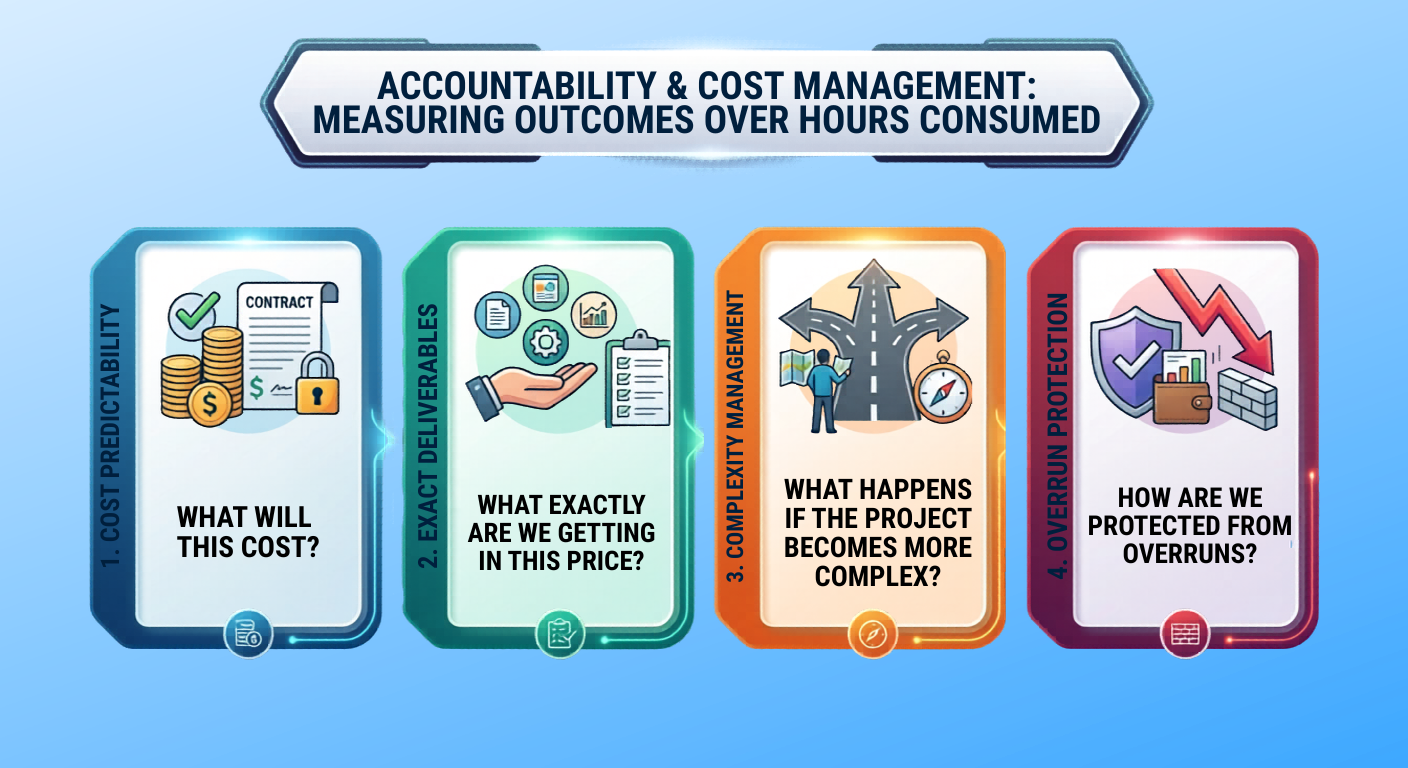
When the focus is on hours consumed, it becomes harder for leadership teams to evaluate progress in terms of outcomes delivered. Associations need to be able to answer simple questions clearly:
4. Postponed issues can become costly later
When teams are trying to control hours in a time-and-materials model, some important clean-up items may get deferred instead of resolved properly. That can include data issues, process simplifications, or reporting needs. Those deferred items often return later as surprise budget overruns.
Why Is a Firm Fixed-Cost Model the Better Choice for Fonteva Implementation?
A firm fixed-cost model changes the conversation in a meaningful way. Instead of focusing on how many hours are being consumed, it focuses on delivering agreed outcomes for an agreed scope.
1. Better cost predictability
A firm fixed-cost model gives associations much greater confidence in budgeting. Leadership teams know what has been committed to the agreed scope, which makes planning, approvals, and governance easier.
2. Stronger delivery discipline
A firm fixed-cost model works best when the implementation partner is disciplined from the start. It aligns the implementation partner around delivery outcomes, milestone ownership, and execution quality. That creates a stronger sense of responsibility around timelines, scope, and overall project success.
3. Lower financial risk
The association is protected from absorbing every additional hour caused by inefficiency, rework, or avoidable ambiguity. That does not eliminate change control, but it does create a much more stable financial foundation for the project.
4. Greater focus on a configuration-first approach
A firm fixed-cost implementation partner is motivated to make the best possible use of Fonteva and Salesforce capabilities before recommending a custom build. That leads to a solution that is easier to support, easier to evolve, and better aligned to platform best practices.
How Aplusify Helps Associations Safeguard Their Fonteva Implementation from Financial Risks
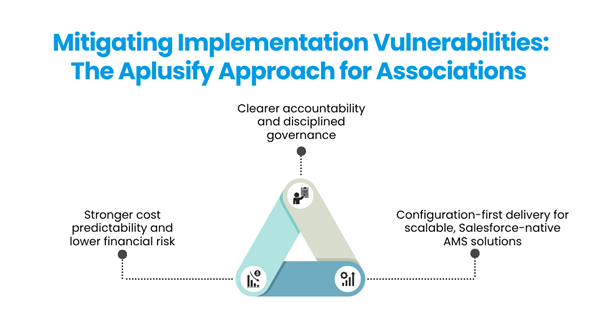
At Aplusify, we understand that associations are not just implementing an AMS. They are modernizing critical member operations. That is why we approach Fonteva implementations with a strong focus on:
- Clear scope definition
- Disciplined requirements and governance
- Configuration-first delivery
- Clean data migration strategy
- Reliable integrations across the association ecosystem
- Long-term scalability on Salesforce
We support firm-fixed-cost Fonteva implementations for an agreed-upon scope because we believe associations deserve both transformation and financial clarity.
A successful implementation should not leave the client guessing about cost or carrying avoidable delivery risk. It should create confidence, control, and a stable foundation for what comes next.
Our approach is built around the specific realities associations face, from renewal complexity to the growing demand for Predictive and Agentic AI. We do not see Fonteva implementation as just a system setup. We see it as deliberately building a scalable, future-ready operating foundation for membership growth, event success, engagement, operational efficiency and AI-driven innovation.
Final Thoughts
For associations evaluating Fonteva implementation partners, the cost model matters just as much as the technical approach. A project can have the right platform and still struggle if the delivery structure and cost model allow cost creep, unclear accountability, and avoidable risk. A well-defined firm fixed-cost model helps associations stay in control—financially, operationally, and strategically. And in a transformation as important as a Fonteva implementation, that control matters.
Evaluating Fonteva implementation partners?
If your association is evaluating Fonteva implementation partners, the pricing model deserves as much attention as the platform itself. The right engagement structure can help you reduce risk, avoid budget surprises, and move into implementation with greater confidence.
Aplusify helps associations implement Fonteva through a firm fixed-cost, configuration-first approach designed to support predictability, accountability, and long-term success.
Connect with us to learn how we can help de-risk your Fonteva implementation.
AuthorBio
Sukanya Deb, Business Development Manager, Aplusify
Meet Sukanya Deb, a seasoned sales professional with over a decade of experience spanning enterprise software, AI-driven analytics, and IT consulting. As part of Aplusify, she helps associations and nonprofits align their goals with the right technologies, like Salesforce, Fonteva, and other Salesforce-based solutions, to drive measurable outcomes across IT, membership, events, and analytics. Always eager to collaborate, Sukanya welcomes meaningful connections.