
In today’s digital era, member expectations are being shaped by seamless, consumer-grade experiences. Whether in retail, banking, or media, people expect responsiveness, personalization, and ease. Associations aren’t exempt from this shift. As your members increasingly compare your offerings to what they experience in their everyday lives, the bar for member experience, member engagement, and member satisfaction is rising.
That’s where an Association Management System (AMS) truly becomes a strategic differentiator. More than just a database, a well-implemented AMS is the backbone of how your association delivers consistent, relevant value to members. It’s where engagement, operations, analytics, and service converge.
Why Engagement and Satisfaction Rely on AMS
On the surface, an AMS can look like a back-office system, a member records storage system, payment processor, or event tracker. But in today’s association, it is the nervous system for your member relationships and value delivery. Here’s why:
Centralized View of Members
One of the biggest strengths of a robust AMS is that it provides a centralized view of members with all their data, interactions, preferences, history, and touchpoints in one place. When your staff can see a member’s:
- event attendance history
- content downloads
- survey responses
- volunteer participations
- support tickets
the staff and the association acquire an integrated knowledge of their behavior, needs, and wants. This richer context is necessary to customize interactions, prioritize engagement, and predict their next step.
If your teams are frozen in silos (e.g. event staff, membership staff, communications staff), they’ll communicate redundant or contradictory messages. But with a centralized AMS, you can align across functions, enhancing the member experience and building trust.
Streamlined Processes Allow More Focus on Value
Staff in most associations today still spend hours on drudge work: reconciling dues, pursuing incomplete profiles, renewals, or consolidating data from spreadsheets. An AMS set up correctly automates these mundane tasks, liberating your team to concentrate on designing programs, outreach, and engagement with substance.
That shift from “doing” to “designing” is what brings your association the speed and responsiveness to react to member needs.
Foundation for Communication, Personalization & Analytics
Without an AMS, personalization is a guess. With one, you’re able to:
- trigger emails or nudges based on member behavior
- segment your audience dynamically
- create AMS workflows for lifecycle outreach
- measure which campaigns actually drive retention
Since the AMS is now the single source of truth, your communication becomes smarter, more relevant, and less likely to overwhelm or annoy members.
Additionally, with analytics integrated, you can input engagement dashboards monitoring real-time trends and comments and then refine your strategies. That feedback loop is the key to maintaining member satisfaction long-term.
Typical Traps in AMS Implementation
Most associations mean well but fall short on AMS adoption. Identifying potential pitfalls early on ensures you can prevent them rather than fix them later.
Treating It as a Tech Project, Not a Change Initiative
All too often, AMS projects are IT-driven and treated as a technical implementation only: choose the system, implement it, go live. However, the most challenging part is not the code; rather, it is adoption, process redesign, and alignment to member goals. Without adoption from staff, leadership, and members, the most capable AMS gathers dust.
Data Migration Without Cleaning and Standardization
With legacy data, there come inconsistencies: duplicate, outdated fields, or incomplete records. Not cleaning this up before migration means such issues will be reflected in your AMS, which can limit the value that one can unlock.
That’s why a structured process of cleaning data is crucial: standardizing fields, removing duplicates, and resolving conflicts to make sure your single member view is both accurate and dependable for analytics and personalization.
Low User Adoption Due to Inadequate Training or Complexity
The best AMS can only be as good as the people using it. When they are overwhelmed, aren’t properly guided, or don’t have adequate documentation, they naturally fall back on their spreadsheets and workarounds. Some associations have a few “superusers” who truly understand the system, while everyone else avoids it. Because of this, the AMS is used very little, and the intended value is not met.
To reverse this, structured onboarding and ongoing role-based training are essential. Clear documentation, practical use cases, and hands-on support build confidence across teams, helping every user fully adopt the system and contribute to the AMS vision.
Misalignment Between AMS Features and Member Journey
If your AMS capabilities do not correspond to interaction points, such as onboarding, renewal reminders, event registrations and support you will encounter inconsistencies. For instance if your AMS handles events but lacks integration, with the member portal members will be required to log in again or enter data redundantly. That friction erodes member satisfaction.
A structured journey-to-system mapping resolves this. Aligning AMS modules, data flows, and integration touchpoints with each stage of the member journey, associations reduce friction, ensure cohesive user pathways, and strengthen engagement across channels.
How to Get Implementation Right
Define Success Upfront
Before you ever select modules or set up workflows, ask yourself: What will success look like for member engagement and member satisfaction?
Define KPIs such as:
- Increased event registration conversion
- Increased renewal rates
- Improved survey satisfaction scores
- Higher non-dues revenue through targeted offerings
When you can measure it, you can manage it.
Stakeholder Alignment, Involve Everyone
Bring together a diverse team across departments: leadership, membership, events, communications, finance, and even a few members. Their feedback on priorities, interfaces, naming, and workflows drives better adoption, alignment and ensures the system truly serves everyone.
Create a Change Management Strategy
- Phased rollout and piloting: Pilot a subset of modules or user groups. Be proactive and adapt.
- Training and Documentation: Make role-based training plans. Skip the 200-page manuals; instead, offer scenario-based, bite-sized learning structures.
- Plan for Communication: Track regular progress, highlight accomplishments, and reward early adopters.
- Support & Champions: Combine internal expertise with a specialized member support team who can be system champions, handling inquiries, guiding members, and providing feedback to continually improve workflows.
Map AMS Features to Member Journeys
Take each critical stage in your member life cycle — onboarding, renewal, engagement, support and ask yourself: How does AMS contribute here? For instance:
- On onboarding: automated welcome messages, profile reminders
- Mid-year engagement: event recommendations, learning pathways, re-engagement prompts
- Renewal: reminders, simple payment links, targeted messaging
- Support: help ticket incorporation, issue tracking
This makes your AMS not a nice-to-have but a mission-critical part of your member journey.
Driving Engagement Through AMS
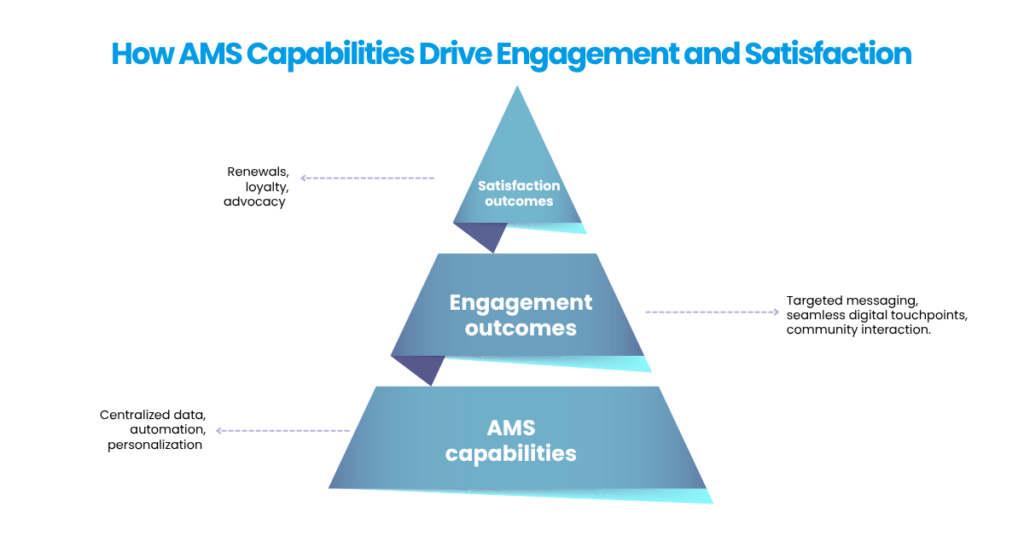
Once up and running, your AMS is a potent force for member engagement. Here’s why:
Personalization at Scale
With a single view of members, your AMS can label preferences (e.g. subject interest, demographics, career level), and dynamically customize content: e-newsletters, event recommendations, learning modules. This prevents “spray and pray” messaging.
By analyzing data (attendance history, portal activity, downloads), you can segment and micro-target messaging that speaks to specific members.
Seamless Digital Touchpoints
Members want to interact online to register for events, comment in online communities, or access resources. When those interfaces integrate closely with your AMS, it is frictionless.
Example:
- One-click event registration (with data pre-filled)
- In-portal access to content (no re-login required)
- Mobile app integration
- Online community integrated directly to AMS profiles
These frictionless experiences lower drop-offs and increase satisfaction.
Guided Member Journey
With the right setup, your AMS makes it easy to nurture relationships at scale. Automation of welcome messages, renewal nudges, and personalized recommendations are all driven by real member interactions. Need to re-engage a person who hasn’t visited an event in 6 months? The system can automatically trigger the right suggestions.
Engagement Dashboards & Insights
Don’t fly blind. Use engagement dashboards to see trends: who’s opening emails, showing up for events, posting in communities, or dropping off. Drill into segments and ask: why some members are less active?
These insights power iterative optimization, allowing you to shift strategy based on data not gut.
Encouraging Community & Peer Interaction
Since your AMS contains membership and event information, you are able to suggest appropriate peer groups, networking, and micro-communities to members. That creates organic engagement more effective than broadcast communications.
Driving Satisfaction Through AMS
Member engagement gets members participating, while member satisfaction keeps them coming back content, appreciated, and willing to renew. Below are how your AMS assists in delivering higher satisfaction.
Frictionless Processes & Self-Service
Frustration kills satisfaction quicker than anything. Your AMS should facilitate:
- Portals allowing members to manage their profile check payment status register for events, access content and manage subscriptions themselves
- Single-click event registration so members won’t need to re-enter their information
- Seamless renewal, automated bills, intelligent reminders, flexible payments
These reduce resistance. Boost assurance.
Consistency Across Channels
Members have the ability to connect via email, mobile application, website platform or social media. Your AMS must provide seamless experience and data across these touchpoints. If their profile update in the portal does not reflect in communications, trust is lost.
Integration with Support Systems (e.g. Service Cloud)
Linking your AMS to a customer/member service (for example, Salesforce Service Cloud) allows you to provide faster, more relevant service. Agents may access their complete membership journey or history when a member submits a support request, allowing them to respond with custom responses. That decreases frustration, accelerates resolution, and increases satisfaction.
Analytics & Feedback Loops
Utilize engagement dashboards not only for activity statistics, but also for feedback: surveys, NPS, satisfaction scores. Connect them back to AMS data to determine what kind of members or activity aligns with high satisfaction, then do it again.
Clarity & Transparency
Members value transparency: what they receive, when their renewals are, how to pay, what’s their history of engagement.
AI is not just an emerging technology today; it’s now central to how your AMS engages, learns, and responds to members. Here’s how AI shifts your AMS from passive data storage to an adaptive, smart system that drives engagement.
Predictive Analytics & Renewal Forecasting
One of the most precious AI applications is renewal forecasting. Analyzing patterns of member behaviors (decline in event attendance, portal usage, renewal history) can help AI models predict members who are most likely to not renew. Associations can take action early with engagement or incentives before they fall away.
Such precision empowers associations to transition from reactive to proactive retention.
AI-Driven Personalization
Consider AI like turbocharging your segmentation. AI models can create segments dynamically or recognize patterns your human team can’t — e.g., members most likely to embrace a new leadership initiative. AI can create personalized content variants at scale, which further boosts member engagement and member satisfaction.
Smarter Automation
With AI infused in AMS workflows, you can automate more smartly. For instance:
- When a member’s activity falls off, send them a follow-up series
- Automatically enforce grace period rules on payments
- Recommend subsequent learning pathways or events based on action
AI assists in minimizing manual rule-messing-around and making workflows smart.
Integrating Intelligence into Finance & Forecasting
The extent of AI’s impact goes beyond operations; it also influences financial accuracy, forecasting, and decision-making. You can develop rolling forecasts of dues revenue, event revenue, and sponsorships, for instance. Systems can generate narrative answers (“Why is our forecast down 3%?”) and alert you to anomalies.
This kind of insight enables leadership to move faster and with confidence.
Don’t Check Off Modules, Map Them to the Member Journey
Rather than checking boxes on modules, align each AMS feature directly to a member touchpoint. Ask: What will a first-year member see, do, feel at every step? Use that as your roadmap.
Invest in Adoption, Not Just Licenses
An expensive license with low adoption is money wasted. Budget time and resources for training, internal champions, ongoing support, and feedback loops.
Begin with Core Needs, Then Grow
There’s no need to launch every module immediately. Start with the core modules (membership, renewals, events, portal) then add capabilities such, as AI, personalization or detailed analytics once usage becomes steady.
Prioritize Data Fitness
Your AI and analytics are no better than your data. Clean, dedupe, validate consent, normalize fields, and audit your system on a regular basis. Bad data will ruin your whole strategy.
Measure, Iterate, Improve
Keep track of your KPIs-engagement, renewal, satisfaction. Use your dashboards to find the weak spots. Run experiments, A/B testing; perform regular optimization.
Governance, Transparency & Trust
When applying AI or automation, have clear policies. Members need to know how their data is utilized. Always attribute automated content, maintain audit logs, and be consistent with privacy laws.
Celebrate Early Wins & Build Momentum
Emphasize early adopters, communicate success stories internally. Momentum is confidence-building and causes other members to follow.
The best AMS implementation is a dynamic strategy. When properly implemented, it is a catalyst, changing operations, improving member engagement, and driving long-term member satisfaction.
From building a centralized view of members to enable self-service portals, incorporating AMS workflows, integration into support systems, to leveraging AI for renewal forecasting, each piece builds on a stronger, more responsive association.
With a wealth of experience in content strategy, copywriting, and marketing, Akanksha is an expert in creating clear, compelling content that resonates with audiences. She excels at translating complex, Salesforce-based technical concepts into simple, effective messaging. At Aplusify, she leads content initiatives that drive clarity, build strong connections, and maintain consistency across all communication channels.