
For over two decades, utilizing Salesforce for non-profits and mission-driven organizations has followed a strict, unwritten rule: if you want to update a record, pull a report, or trigger an automation, you must open a web browser, log in, and navigate a sea of tabs, page layouts, and dashboards. Whether you are a membership director tracking dues, a fundraiser logging major donor touchpoints, or an association executive verifying event metrics, the browser user interface (UI) has been your mandatory gatekeeper. At TrailblazerDX (TDX) 2026, Salesforce shattered this foundational paradigm with the announcement of Salesforce Headless 360.
With the bold tagline “No Browser Required,” Headless 360 completely decouples Salesforce’s underlying data, workflows, and business logic from the traditional browser-based interface. By transforming the entire platform into an API-first ecosystem, Salesforce has evolved from a destination app into an invisible, hyper-programmable engine designed explicitly for the era of artificial intelligence and automated workflows. While commercial enterprises are leveraging Headless 360 to accelerate software development and scale customer service, what does an application with “no user interface” mean for those deploying association management solutions? It means your staff can step away from administrative data entry and return to what matters most: your mission, your members, and your impact.
Deconstructing the Tech: What Exactly is "Headless"?
In software architecture, the “head” refers to the front-end user interface—the visual screens, buttons, and layouts that humans click on to get work done. “Headless” software uncouples that visual surface from the powerful back-end database and business logic engine.
According to the official announcement by Salesforce, Headless 360 packages the core capabilities of Customer 360, Data 360 (Data Cloud), and Agentforce into a highly accessible, programmable platform. Under this model, every capability on Salesforce is bucketed into three developer- and AI-friendly interfaces:
- REST APIs: The foundational data pipelines that allow external applications to securely read, write, and sync data.
- Model Context Protocol (MCP) Tools: An open, standardized protocol that acts as a universal connector. It allows AI engines (such as Claude Code, Cursor, or Salesforce’s Agentforce) to instantly “discover” what Salesforce can do and execute those functions natively.
- CLI Commands: Text-based instructions allowing rapid developer configuration and automated scripting.
By moving your organization’s business logic out of the proprietary browser view and into an agnostic code layer, Salesforce enables software agents and external environments to coordinate work automatically. It moves your operations from a simple system of record to an automated system of execution.
1. Radical Efficiency and Nonprofit Database Automation
The single greatest challenge facing the average nonprofit is a shortage of time and administrative bandwidth. Staff members frequently wear multiple hats, moving from donor outreach to event planning to grant reporting. Too often, valuable hours are eaten up by manual data entry or hunting down information hidden across deep Salesforce object tabs.
Headless 360 introduces an infrastructure where software can act without a human trigger, paving the way for complete nonprofit database automation. Because an AI agent can interact directly with the Salesforce backend via MCP tools, it can manage complex administrative tasks autonomously.
Consider the typical grant management workflow:
- The Old Way: A program officer receives an automated email reminder, logs into Salesforce, clicks into the Grants tab, finds the active record, manually changes the status to “Report Submitted,” uploads a PDF, and manually triggers a notification email to the finance team.
- The Headless Way: An AI agent monitoring a shared inbox detects that a foundation partner has emailed a grant report. Utilizing Headless 360 APIs, the agent reads the email context, automatically validates the document against open criteria, updates the specific grant milestone in the Salesforce backend, attaches the document, and alerts finance via Slack—all without a staff member ever opening a browser.
By removing the “UI tax”—the time spent waiting for pages to load, clicking through menus, and manually entering fields—lean nonprofit teams can reclaim dozens of hours every month.
2. Elevating Member & Donor Engagement via the "Experience Layer"
Organizations utilizing modern association management solutions live and die by the quality of their member experience. Yet, members rarely want to interact with a rigid CRM interface. They want to engage on the platforms they already use daily: WhatsApp, Slack, SMS, or custom web portals.
Previously, providing a unified experience across all these channels meant building separate, siloed applications for each surface, leading to massive middleware costs and mismatched data.
Headless 360, paired with Salesforce’s new Agentforce Experience Layer, solves this by allowing an organization to describe its workflow or engagement logic just once. Because the system is headless, that single piece of business logic can be rendered natively across diverse interaction surfaces simultaneously.
As outlined in the architecture diagram below, Headless 360 acts as the central translator between your core data and your front-end channels:
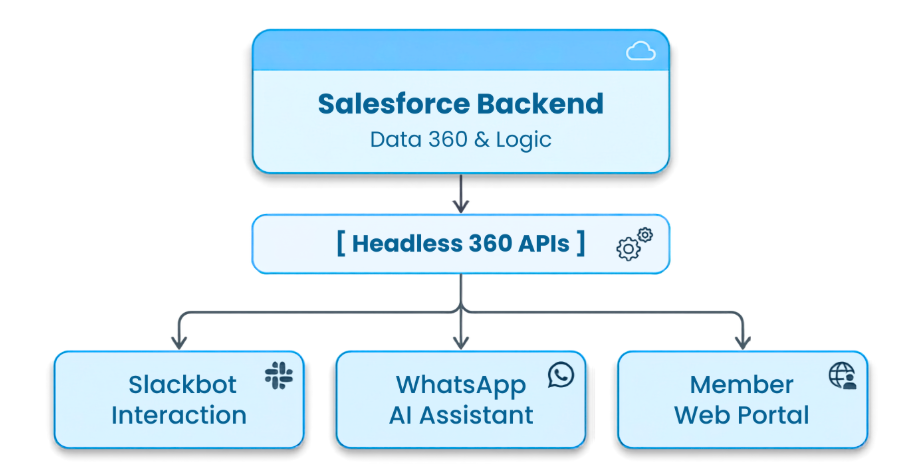
For an association managing a major annual convention, this opens up incredible possibilities. A member can message a WhatsApp bot saying, “I need to upgrade my ticket to a VIP pass and change my dietary restrictions.”
Instead of an automated message telling the member to log into their member portal, the headless AI agent directly calls the Salesforce backend via an API tool, processes the payment tier adjustment, updates the contact record fields, and returns a clean, interactive confirmation native to the WhatsApp chat window. The member gets an immediate response, and the association’s member database remains flawlessly updated.
3. Demystifying Complex Data with Salesforce AI for Associations
Nonprofits sit on mountains of highly valuable, disparate data—donation patterns, event attendance metrics, volunteer availability logs, and program outcomes. The challenge has never been collecting the data; it has been synthesizing it into actionable strategies.
Because Headless 360 integrates natively with Data 360, the underlying data mesh is completely liberated from standard page layouts. Deploying Salesforce AI for associations means AI data agents can query the entire organizational ecosystem dynamically to spot trends that a human scrolling through tabular reports would likely miss.
For example, a headless analytics agent could run continuous backend audits to flag donor attrition risks. It can track if a historically reliable mid-level donor has missed the last two quarterly giving cycles, hasn’t opened recent newsletters, and dropped out of an event registration.
Instead of requiring a development director to build a complex cross-filtering report at the end of the fiscal quarter, the headless system constantly evaluates these indicators in the background. It can autonomously trigger a task or surface an alert directly into a fundraiser’s Slack workspace, noting: “Donor X shows a high probability of lapsing. Click here to view a generated, personalized outreach draft based on their past giving history.”
4. Slashing Technology and Maintenance Overhead
Many mid-sized associations and charities find themselves trapped in a cycle of high IT maintenance costs. Every custom page layout, custom Lightning Web Component (LWC), or third-party integration requires continuous oversight. When Salesforce rolls out seasonal platform upgrades, custom user interfaces are frequently the first things to break, resulting in costly consultant troubleshooting hours.
By transitioning toward a headless infrastructure, organizations can significantly reduce their “technical debt.”
When you enforce your business logic at the core platform level via APIs rather than relying on the interface layout to dictate the process, your system becomes incredibly resilient. You no longer need to worry if an updated browser version or a changed desktop view will break your custom volunteer signup forms.
Furthermore, a successful Salesforce Agentforce implementation allows an organization’s IT staff or external partners to build and test code much faster. Developers can hook external AI coding agents directly into a Salesforce developer sandbox using open protocols, enabling them to build, evaluate, and deploy new programmatic guardrails in days rather than months. For budget-conscious nonprofits, this translates directly to reduced implementation fees and a much higher return on technology investment.
The Road Ahead: Balancing Innovation with Governance
As compelling as the “No Browser Required” future sounds, migrating to a headless architecture is a strategic journey, not an overnight switch. For teams planning a modern Salesforce Agentforce implementation, success requires focusing on three fundamental pillars:
- Clean Up the Core Data: Headless AI agents are entirely dependent on the quality of the data they can access. If your Salesforce org is filled with duplicate records, outdated member statuses, and abandoned custom fields, an AI agent will struggle to execute actions reliably. Prioritizing data hygiene is a vital first step.
- Define Strict Guardrails: Because headless systems allow software to make decisions and alter data without human clicks, establishing strong governance is critical. Salesforce addresses this via tools like Testing Center, Custom Scoring Evals, and Session Tracing, allowing you to establish exact user permissions and limit AI scopes so an agent can update a mailing address or send an event ticket, but cannot autonomously alter macro-level fundraising configurations or delete historical donor archives.
- Embrace a Hybrid Mindset: Moving to a headless model does not mean your staff will never log into Salesforce again. Financial teams will still want a clear visual UI for deep auditing, and system administrators will always need a visual dashboard to monitor operations. Think of Headless 360 as an expansion pack—it creates a highly efficient, automated fast-lane for day-to-day engagement, while leaving the classic browser application available for deep human oversight.
Embracing an Agentic Future
The announcement of Salesforce Headless 360 marks the beginning of a new chapter in enterprise software—the transition from an app-centric workforce to an agentic workforce.
For the modern ecosystem of Salesforce for non-profits, this shift is profoundly democratizing. It means that technology can finally step into the background, operating as an invisible, intelligent assistant that handles the friction of database management, record updates, and routine communications.
By removing the browser bottleneck, Headless 360 empowers mission-driven organizations to step away from their screens and return to the heart of their work: building communities, cultivating real human relationships, and driving meaningful societal change.
FAQs
The primary benefit is the elimination of administrative overhead and browser dependency. By making Salesforce an API-first engine, AI agents and external tools can autonomously log donor interactions, update member records, and execute background workflows. This frees up lean staff teams from the “UI tax” of manual data entry, allowing them to focus directly on community outreach and mission-critical work.
No, the traditional Salesforce browser interface is not going away. Headless 360 is an extension of the platform, not a replacement. While day-to-day data updates, member self-service tasks, and automated workflows can run entirely behind the scenes via AI agents, your system administrators, data analysts, and finance teams will still use the standard browser UI for high-level configuration, deep auditing, and strategic reporting.
Yes, security is built directly into the headless framework. When an AI agent, external application, or developer invokes a capability via Headless 360 APIs or MCP tools, Salesforce enforces four critical layers of security natively: User Identity (the caller acts with specific user credentials), Access Control (sharing rules and permission sets apply), Field-Level Security (restricting hidden or sensitive data fields), and the built-in governance rules of the Einstein Trust Layer.
Headless 360 connects with Data 360 and the Agentforce Experience Layer to deliver frictionless, real-time responses across the digital communication channels your members already prefer, such as WhatsApp or Slack. Furthermore, autonomous backend agents can constantly audit engagement data to flag members who are at a high risk of lapsing, prompting your staff with personalized outreach recommendations before the membership expires.
Author Bio
- Preeti Deepa Dash
- Marketing Operations and Revenue Expert, Aplusify
Preeti Dash is a marketing professional at Aplusify with 7 years of experience in technology marketing and communications. She works closely with associations and nonprofits to simplify the value of Salesforce and AMS solutions through strategic storytelling and educational initiatives, helping organizations navigate digital transformation and enhance member engagement.