
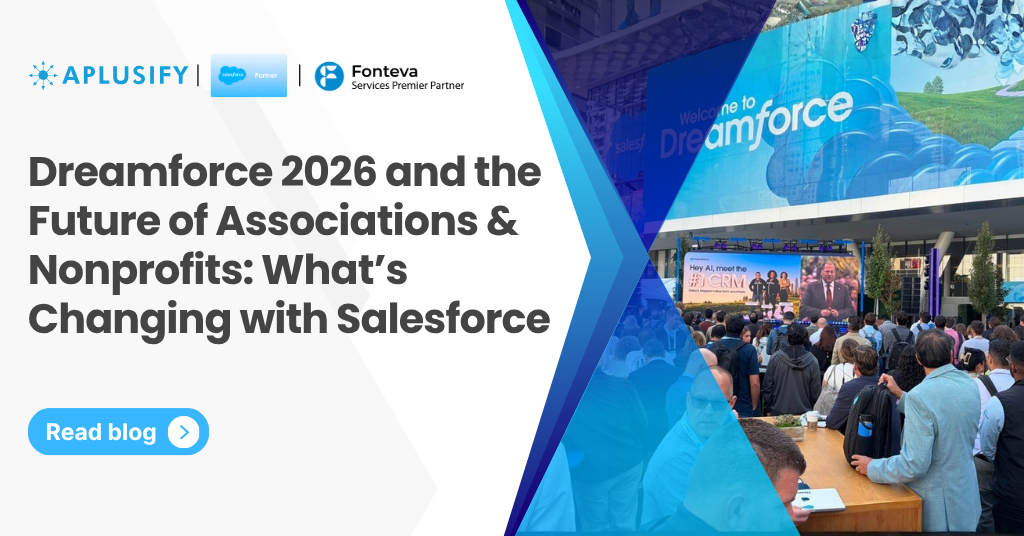
The ecosystem shifted beneath our feet at Dreamforce.
Between Marc Benioff unveiling AIforce, Anthropic’s Dario Amodei demonstrating Claudeforce, and NVIDIA’s Jensen Huang emphasizing that enterprise software isn’t dying—it’s evolving—the underlying theme was undeniable: the traditional CRM interface is stepping into the background.
For association executives, non-profit operational leaders, and membership directors, the message was loud and clear: Salesforce is moving toward an ecosystem where AI brings the data to your team wherever they already work, rather than forcing your team into Salesforce.
Here is a breakdown of the major takeaways from the Dreamforce Keynote and what they mean for member-driven organizations and non-profits.
1. AIforce & "AI Replacing the UI": Working Where Staff Actually Work
The flagship announcement at Dreamforce was AIforce—Salesforce’s shift toward a “headless” or agentic CRM model. Instead of requiring staff to log into Salesforce, open accounts, and navigate standard Lightning record pages, AIforce brings Salesforce logic and data directly into tools like Claude, Slack, and custom workspaces.
What it means for Associations & Nonprofits:
- Elimination of User Adoption Friction:
A major bottleneck for non-profit teams—from event coordinators to major gift officers—is logging into Salesforce to record interactions or check member status. With AIforce, an event manager inside Slack or Claude can ask, “What is the renewal status for Member X?” or “Log this call with Donor Y,” and Salesforce updates seamlessly behind the scenes. - Lower Training Costs for Staff & Volunteers:
Associations often deal with seasonal staff, temporary workers, or non-technical program leads. Decoupling CRM power from the native UI means staff don’t need to master complex navigation menus to capture critical data.
2. Claudeforce & Slackforce: Conversational Workflows for Member & Donor Insights
Salesforce highlighted Claudeforce (a deep integration with Anthropic’s Claude powered by Model Context Protocol/MCP) and Slackforce. Demoed live, executives showed how staff can construct custom command dashboards or execute 30+ pre-built skills simply by holding natural language conversations with AI.
What it means for Associations & Nonprofits:
- Instant Executive & Board Reporting:
Instead of asking an administrator to build custom reports for board meetings, an association CEO can ask Claude: “Summarize our top 10 lapsed enterprise members this quarter, their committee participation history, and draft a outreach outline for each.” - Enhanced Donor & Member Engagement:
Development officers preparing for a major donor lunch can pull comprehensive donor histories, lifetime giving totals, and recent event attendance directly from Slack or Claude in seconds.
3. Uncompromising Security: "Zero Data Retention" & Non-Profit Trust
A core highlight from Marc Benioff’s address focused on enterprise trust and security: Salesforce models operate on a Zero Data Retention policy. Your constituent data, donor histories, and member privacy rights are never used to train external LLMs.
What it means for Associations & Nonprofits:
- Compliance & Member Trust:
Nonprofits and associations handle sensitive donor records, personal contact data, and often medical or financial data (e.g., credentialing or advocacy groups). Knowing that AI queries don’t expose constituent data to public training sets gives leadership the confidence needed to adopt agentic AI.
4. "It’s Not the SaaSpocalypse": Your CRM Core Matters More Than Ever
Refuting claims that generative AI will make traditional CRMs obsolete, Salesforce leadership made a strong point: AI is a layer on top of software, not a replacement for your core data engine.
What it means for Associations & Nonprofits:
- Data Cleanliness is the Priority:
AI agents are only as smart as the data underneath them. If your non-profit has duplicate contact records, outdated event logs, or unsegmented member types, an AI layer will only amplify those errors. - Nonprofit Cloud (NPC) & Experience Cloud remain foundational:
The core system of record—housing your business rules, membership tiers, dues schedules, and payment gateways—remains vital. AIforce relies on your underlying Salesforce architecture to reason and act safely.
5. Debunking the "SaaSpocalypse": Software Isn't Dying, It's Evolving
Throughout 2026, tech headlines warned of a impending “SaaSpocalypse”—a narrative suggesting generative AI agents would completely replace traditional enterprise software platforms. Marc Benioff tackled this head-on during his opening address:
“We’ve been hearing all this kind of crazy nonsense about the SaaSpocalypse, especially over the last six months. Hasn’t it been wild? But I think we realized that the SaaSpocalypse—it’s not about the end of software, but it may be about the end of software that makes humans do all the work.” — Marc Benioff, CEO, Salesforce
NVIDIA CEO Jensen Huang echoed this sentiment when joining Benioff on stage:
“I was the first CEO to come out… to say the end of software is nonsense. This is going to be a layer on top of software. This new layer is going to be agentic, and it’s going to make software so much better.” — Jensen Huang, CEO, NVIDIA
What It Means for Associations & Nonprofits:
- Your CRM Core Remains Essential:
Non-profits do not need to throw out their core databases or fear their technology stack is becoming obsolete. The underlying data structure, business rules, and historical records built into Salesforce are more critical than ever. - AI Needs Grounding:
As Benioff noted during the keynote, “Models alone cannot run the enterprise.” AI requires the trusted business logic and historical donor/member context that sits inside your system of record to operate without making errors.
How Nonprofits & Associations Should Prepare
Dreamforce clearly signaled that the AI revolution is moving from basic text generation to agentic workflows. To get your organization ready for tools like Claudeforce and AIforce, focus on three key steps:
- Audit Your CRM Data Architecture:
Clean up duplicate records, establish consistent data entry rules, and ensure your core Salesforce object relationships (Members, Subscriptions, Donations, Events) are structured cleanly. - Identify High-Friction Workflows:
Find where your staff spend time context-switching between emails, Slack, spreadsheets, and Salesforce. These are your prime candidates for initial AI agent deployment. - Establish AI Governance:
Ensure your staff understands how zero-data-retention AI works and create guidelines around constituent data privacy before turning on integrations.
Need Help Preparing Your Salesforce Architecture for AI?
Whether you’re migrating to Salesforce Nonprofit Cloud, optimizing your Association Management System (AMS), or laying the groundwork for Agentforce and AI integrations, Aplusify is here to help.
Frequently Asked Questions
What is the biggest Dreamforce 2026 takeaway for associations?
The biggest relevant shift is Salesforce’s move toward an agentic ecosystem where AI can access CRM data and workflows through multiple interfaces and help users take action. For associations, this could affect member service, engagement, events, fundraising and internal operations.
How will Dreamforce 2026 affect nonprofits?
Dreamforce 2026 reinforces Salesforce’s focus on using AI to improve nonprofit staff productivity, fundraising and mission delivery. Salesforce is also highlighting Nonprofit Cloud and Agentforce capabilities specifically for nonprofit organisations.
What is AIforce?
AIforce is Salesforce’s broader framework for bringing Salesforce data, context and workflows into different interfaces and agentic experiences. The Dreamforce 2026 keynote highlighted experiences involving Claude, Slack and Salesforce itself.
What is Agentforce Coworker?
Agentforce Coworker is positioned as an AI teammate within Salesforce that can help users access information and complete work. Dreamforce 2026 demonstrations included use cases such as daily priorities, mobile access and meeting preparation.
Author Bio
- Preeti Deepa Dash
- Marketing Operations and Revenue Expert, Aplusify
Preeti Dash is a marketing professional at Aplusify with 7 years of experience in technology marketing and communications. She works closely with associations and nonprofits to simplify the value of Salesforce and AMS solutions through strategic storytelling and educational initiatives, helping organizations navigate digital transformation and enhance member engagement.